24 August AD 79?
New archaeological evidence suggests that one of the most famous dates in ancient history may be wrong.
Few events from antiquity are documented as thoroughly as the destruction of Pompeii. Historians possess an eyewitness account from Pliny the Younger, thousands of archaeological finds, inscriptions, coins, food remains, and the results of more than two centuries of excavation. Given such an abundance of evidence, one might assume that the basic facts of the disaster were settled long ago. The reality is more complicated. Nearly two thousand years after Mount Vesuvius buried the city, scholars still debate one of the most fundamental questions: when did the eruption actually occur?
The traditional date of 24 August AD 79 derives from surviving copies of Pliny's letters describing the catastrophe. For generations, that date appeared in textbooks, museum exhibits, and popular histories. Archaeological discoveries over the past several decades have complicated that picture. Evidence recovered from Pompeii suggests that life may have continued well into the autumn, raising questions about whether later copyists preserved Pliny's original date accurately.
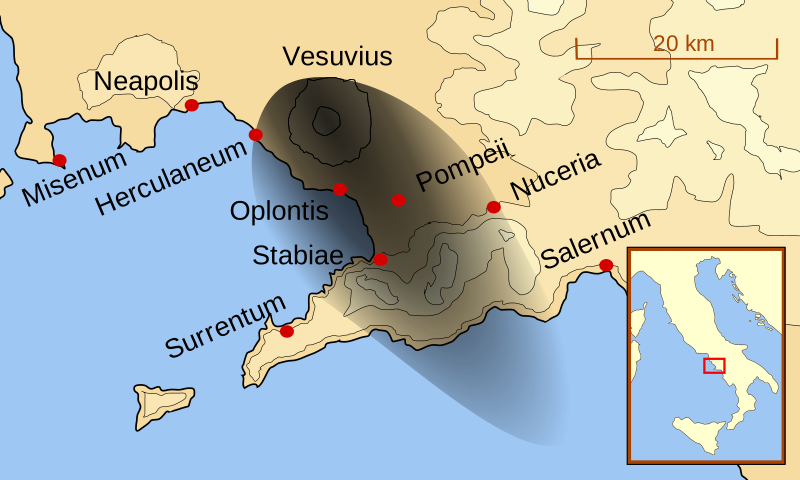
The path of ash and pumice from Mount Vesuvius can be mapped with considerable precision. The exact date of the eruption remains a matter of debate. Map created by MapMaster (2007), Wikimedia Commons. Based on archaeological and volcanological studies of the AD 79 eruption and the distribution of ash fall across Pompeii, Herculaneum, Stabiae, and surrounding communities. Licensed under Creative Commons Attribution-ShareAlike (CC BY-SA 3.0).
The controversy exists because the traditional date rests on a surprisingly fragile foundation. Pliny's letters survive not as original documents but through manuscript traditions copied centuries after the eruption. Different manuscript families preserve different dates, leading some historians to suspect that a copying error entered the textual record at some point during transmission. For much of modern scholarship, however, the August date remained largely unquestioned because no compelling body of archaeological evidence existed to challenge it. Only as excavations accumulated new discoveries did the discrepancy between the written record and the material record become increasingly difficult to ignore.
Among the most persuasive clues are the remains of seasonal foods recovered from the site. Archaeologists have identified pomegranates, chestnuts, walnuts, dried figs, and grapes, all products more closely associated with the autumn harvest than with late August. Additional evidence comes from clothing and household items found throughout the city. Some victims appear to have been wearing garments better suited to cooler weather, and braziers used for heating have been discovered in several locations. None of these observations proves a later eruption date on its own, but together they suggest conditions more consistent with October than with late August.
The debate intensified in 2018 when archaeologists uncovered a charcoal graffito in a house undergoing renovation. The inscription appears to reference a date corresponding to 17 October. Because charcoal markings are fragile and unlikely to survive for long, many scholars believe the notation was written shortly before the eruption. If that interpretation is correct, daily life continued in Pompeii nearly two months beyond the traditional date.
The famous House of the Golden Bracelet contributes another important piece of evidence. The house takes its name from an extraordinary gold bracelet weighing more than 600 grams, found among the possessions of residents attempting to escape the eruption. Archaeologists also recovered jewelry, valuables, and a substantial cache of coins gathered together during what appears to have been a hurried escape. Among those coins was an issue of Emperor Titus whose titulature suggests a minting date later than the traditional August chronology comfortably allows. The coin does not resolve the debate by itself, but it joins a growing body of evidence pointing in the same direction. Considered individually, each clue invites debate. Considered together, they form a cumulative case that has persuaded many scholars to reconsider the traditional date.
At first glance, the difference between August and October may seem trivial. Pompeii was destroyed either way. Historians, however, view chronology as the framework upon which interpretation rests. A later eruption date helps explain the presence of autumn fruits, heating braziers, and recently minted coins. More importantly, it changes how scholars understand the final weeks of life in the city. Residents would have been preparing for a different season, participating in different economic activities, and responding to different environmental conditions.
The date also carries religious significance. Roman civic and religious life followed a dense calendar of festivals, sacrifices, and seasonal observances. An eruption in late August would have occurred within a different ritual and agricultural cycle than one in October. A later date places the catastrophe closer to the autumn harvest season, when communities were gathering crops, storing food, and participating in festivals associated with agricultural abundance. Determining the timing of the eruption therefore helps historians reconstruct not only economic activity but also the cultural and religious rhythms that shaped daily life in Pompeii.
Pompeii presents a useful reminder of the challenges historians face when reconstructing the ancient world. Modern readers often assume that important events can be assigned precise dates, yet historical evidence rarely functions with such precision. Manuscripts survive through copies made centuries after the originals. Inscriptions may be incomplete or damaged. Archaeological layers reveal sequences and relationships rather than exact moments in time. Even scientific methods such as radiocarbon dating generally provide ranges rather than specific days. Historians therefore reconstruct the past from multiple forms of evidence, weighing probabilities rather than establishing absolute certainty.
What makes Pompeii remarkable is not a lack of evidence but the sheer abundance of it. Archaeologists can reconstruct what residents ate, wore, owned, purchased, and carried in their final hours. Scholars know the layout of homes, businesses, temples, and workshops in extraordinary detail. Yet despite this wealth of information, the precise date of the eruption remains disputed. If uncertainty persists in one of the best documented events of antiquity, the difficulties of reconstructing less well preserved periods become easier to appreciate.
The continuing debate over Pompeii's destruction demonstrates that history is not a static collection of established facts. New discoveries have the power to challenge long accepted interpretations, even when those interpretations appear firmly settled. A gold bracelet, a cache of coins, seasonal fruit, and a charcoal note on a wall have reopened a question that many believed had been settled generations ago. Nearly two thousand years after Vesuvius erupted, Pompeii continues to reveal new evidence and, with it, new reasons to rethink the past.
Further Reading
- Serafina Kenny, “Archaeologists and Historians Still Haven't Solved Pompeii's Biggest Mystery. Here's Why,” HistoryExtra, 26 May 2026.
- Jess Venner interviewed by Kev Lochun, HistoryExtra Podcast.
- Pliny the Younger, Letters VI.16 and VI.20.