Matt Damon's Tattoos Didn't Belong on Odysseus
A humorous story from the set of Christopher Nolan's The Odyssey leads to a larger historical investigation into whether ancient Greek heroes had tattoos, drawing upon Homer, Herodotus, Greek art, archaeology, and modern conservation science.
Christopher Nolan recently shared an amusing production challenge from the set of The Odyssey. Like many younger actors, Matt Damon arrived with modern tattoos that had to disappear before filming could begin. Every shooting day required makeup artists to conceal the artwork beneath layers of foundation, only to repeat the process whenever costumes rubbed against skin or weather undid their work. Nolan joked that he expected the younger cast members to have tattoos. Discovering that his Odysseus did as well prompted an exasperated reaction: "Not you as well."
Behind the humor lies a surprisingly serious historical question. Would Odysseus have had tattoos?
Matt Damon's tattoos are not random decorations. His first tattoo honors his wife, Luciana "Lucy" Barroso. Later he added the names of their four daughters, Alexia, Isabella, Gia, and Stella in delicate script on his upper left arm, along with a small matching family symbol. Their deeply personal meaning explains why Damon admitted he assumed his "bare bicep days were over" and never expected to portray a Bronze Age hero whose arms would be on full display.
Nothing in Homer's Odyssey or the Iliad suggests that Greek heroes decorated their bodies with permanent ink. Homer pays remarkable attention to physical appearance. He describes scars, armor, helmets, cloaks, shields, hairstyles, and distinctive injuries. In Book XIX of the Odyssey, Odysseus' famous scar becomes one of the epic's most memorable narrative devices. Received during a boar hunt on Mount Parnassus in his youth, the wound leaves a permanent mark that allows his old nurse Eurycleia to recognize him twenty years later as she washes the feet of the disguised stranger. Homer even interrupts the narrative to recount how the boar's tusk gashed the young prince, how the wound was treated, and how it healed into a lifelong scar. Permanent markings on the body clearly mattered to Homer. Yet tattoos never appear. Equally striking, the scar that plays such a pivotal role in the epic rarely appears in Greek or Roman sculpture, even in representations identified as Odysseus (see image below). Ancient artists consistently emphasized the hero's beard, traveler's cap, and idealized physique, but not the physical mark that Homer made central to his identity.
Had decorative tattoos formed part of the heroic Greek ideal, Homer's extraordinary attention to Odysseus' body makes their omission difficult to dismiss as mere coincidence. Silence alone does not prove their absence. Historians therefore turn to other forms of evidence.

Odysseus (Ulysses), Roman Imperial marble copy of a Hellenistic Greek original from the Pergamon school, created between the late third and mid second century BCE, with sixteenth century restorations by Tiziano Aspetti. The statue, originally discovered in Rome, entered the collection of Cardinal Giovanni Grimani before being acquired by the Republic of Venice in 1523. Museo Archeologico Nazionale di Venezia, Inv. No. 98. The sculpture portrays Odysseus with his characteristic beard and traveler's cap (pilos), hallmarks of his iconography in Greek and Roman art. Consistent with Homer's description and the broader artistic tradition, the exposed body bears no decorative tattoos, reinforcing the article's discussion of the untattooed heroic ideal in ancient Greece. Ancient sculpture: public domain. Photograph by Didier Descouens, taken 11 May 2023, released under the Creative Commons Attribution ShareAlike 4.0 International (CC BY-SA 4.0) license via Wikimedia Commons. Photograph recognized by Wikimedia Commons as a Valued Image.
The Argument from Greek Art
Greek artists produced thousands of images of heroes across painted pottery, monumental sculpture, and temple architecture. If decorative tattoos formed part of elite Greek identity, one might expect them to appear somewhere within this enormous artistic record.
The evidence points in another direction.
Archaic kouroi, the freestanding statues representing the ideal young Greek male, survive in remarkable numbers. Many preserve traces of their original paint. Modern scientific analysis has identified pigments used for flesh tones, hair, eyebrows, lips, and eyes. Decorative tattoos, however, have not emerged from accepted reconstructions.
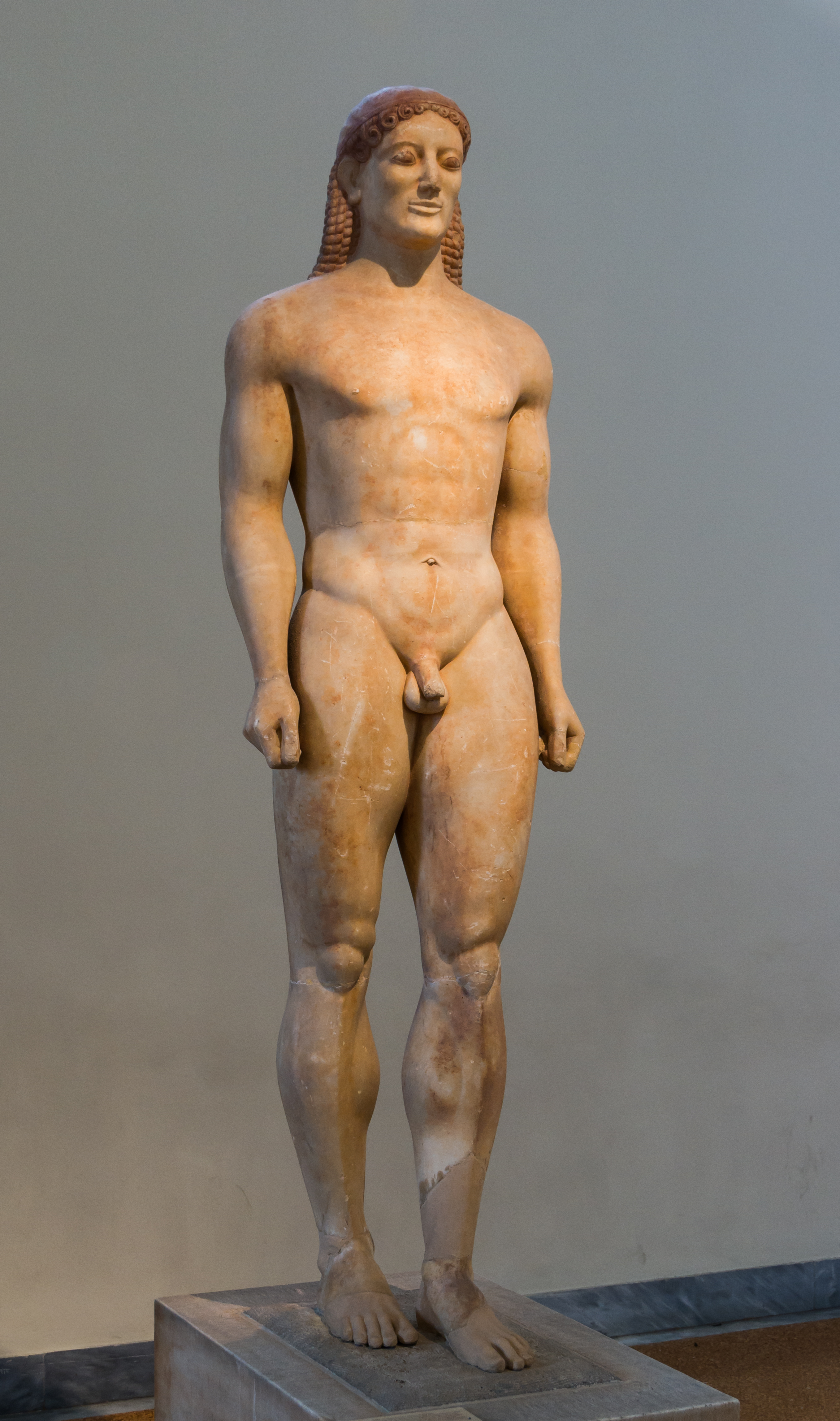
Kroisos Kouros (Anavyssos Kouros), c. 530 BCE. Carved from Parian marble, this funerary statue was erected over the grave of the young warrior Kroisos at Anavyssos, Attica. An inscription on the base commemorates his death in battle: "Stop, and mourn at the grave of the dead Kroisos, whom the raging Ares destroyed as he fought among the foremost warriors." National Archaeological Museum, Athens, Inv. No. 3851. Kouroi embodied the Archaic Greek ideal of the youthful male through carefully rendered anatomy and originally painted surfaces. Modern analysis has identified traces of pigments on comparable kouroi, including flesh tones, hair, eyes, and lips, yet no accepted reconstruction depicts decorative tattoos. The statue therefore provides an important line of evidence in the article's discussion of the untattooed heroic ideal in ancient Greece. Ancient sculpture: public domain. Photograph by Jebulon, taken 20 May 2015, dedicated to the public domain under the Creative Commons CC0 1.0 Universal Public Domain Dedication via Wikimedia Commons. Wikimedia Commons Quality Image.
The same pattern appears in the great temple sculptures. The warriors of the Temple of Aphaia on Aegina, many representing heroes of the Trojan War, display detailed anatomy, armor, helmets, and wounds. The sculptures from the Temple of Zeus at Olympia celebrate heroic bodies with equal precision. The Parthenon continues the tradition, presenting gods and heroes with extraordinary attention to anatomy and movement. Modern pigment studies have recovered evidence for painted skin, garments, shields, armor, and decorative ornamentation, yet no accepted reconstruction depicts tattooed heroic figures.
Even Odysseus himself appears repeatedly in ancient sculpture. Roman copies preserve earlier Greek artistic traditions, portraying him with his characteristic beard and traveler's cap. His body remains unmarked by decorative tattoos.
Absence of evidence does not prove that no Greek ever wore a tattoo. It does suggest something more specific. The artistic ideal of the heroic Greek body appears to have been untattooed.
Herodotus Changes the Picture
Several centuries later the literary evidence changes.
By the fifth century BCE, tattoos unquestionably existed throughout the eastern Mediterranean. Our best literary witness is Herodotus, often called the Father of History. Writing about the Thracians north of Greece, he observed that tattoos marked noble birth and social prestige.
"To be tattooed is regarded as a mark of noble birth; not to be tattooed is a sign of low birth."
That single sentence carries remarkable historical weight.
Herodotus was not explaining what tattoos were. He assumed his Greek readers already understood the practice. Instead, he emphasized that another culture attached an entirely different meaning to them. Among the Thracians, tattoos signaled aristocratic status. Greeks generally associated tattoos with foreigners, slaves, prisoners, or punishment.
One sentence therefore reveals two neighboring civilizations using the same practice to express opposite social values.
Later writers including Xenophon, Plutarch, Strabo, and Julius Caesar also describe tattooing among various peoples. Ancient texts leave little doubt that tattooing was familiar throughout the Mediterranean world.
Archaeology Writes Where History Cannot
Human skin rarely survives for thousands of years. Most ancient bodies decompose completely, taking any tattoos with them. But occasionally nature preserves the impossible.
The frozen body known as Ötzi the Iceman, discovered in the Alps in 1991, dates to approximately 3300 BCE. More than sixty tattoos remain visible on his skin. Many consist of short lines positioned near joints affected by arthritis, leading researchers to suggest they may have served therapeutic rather than decorative purposes. Ötzi predates the Trojan War by nearly two thousand years, proving that tattooing was already an ancient tradition long before Homer's heroes.
Egypt provides another remarkable source of evidence. Naturally preserved mummies still retain skin carrying tattoos after more than three millennia. Some bear geometric patterns, while others display recognizable figures including animals. Advances in infrared photography continue to reveal tattoos overlooked by earlier archaeologists because pigments faded beyond ordinary sight.
Perhaps the most spectacular examples come from the frozen burial mounds of the Altai Mountains. The Pazyryk mummies remained sealed beneath ice for over two thousand years. Their skin preserves elaborate images of deer, felines, griffins, and mythical creatures executed with astonishing artistic sophistication.
Remarkably, historians do not rely only on tattoos that remain visible. Infrared imaging, multispectral photography, microscopy, CT scanning, and chemical analysis of pigments embedded within preserved skin often reveal markings invisible to the naked eye.
Human skin, normally among the least durable materials in archaeology, occasionally becomes one of its richest historical archives.
Bringing the Evidence Together
Historians rarely depend upon a single source of evidence. Homer describes scars but never tattoos. Greek artists repeatedly celebrated the heroic body in painted pottery, monumental sculpture, and temple pediments, yet they left it free of decorative tattoos. Herodotus records tattooing among neighboring peoples and explains how Greeks understood the practice, while archaeologists have recovered tattooed skin from Egypt, the Alps, and the Eurasian steppes. Modern scientific techniques have even revealed pigments hidden beneath aging tissue that escaped detection for centuries. Each line of evidence reinforces the others.
Taken together, the literary, artistic, and archaeological record leaves little doubt that tattooing was widespread throughout the ancient world. The more interesting historical question is not whether ancient people had tattoos, but which cultures embraced them and what those tattoos signified. For the Greeks, the surviving evidence consistently points toward an ideal heroic body that remained free of decorative tattoos.
Christopher Nolan was probably not thinking about Homer, Herodotus, pigment analysis, or frozen mummies when makeup artists spent hours covering Matt Damon's tattoos for The Odyssey. His concern centered on historical authenticity. Ironically, literature, archaeology, and Greek art all point in the same direction.
Homer gave Odysseus one permanent mark upon his body. During a youthful boar hunt on Mount Parnassus, the future king received a deep wound that left a lifelong scar. After twenty years away from Ithaca, his old nurse Eurycleia recognized him not by his face, his voice, or even his clothing, but by that scar. Greek artists celebrated that same heroic body in marble, bronze, painted pottery, and temple sculpture, yet they left it free of decorative tattoos. Nolan's makeup artists removed Matt Damon's modern ink from the screen, but in doing so they may have preserved one of the film's most historically authentic details.
Further Reading
- Herodotus. Histories, Book V. (Tattooing among the Thracians)
- Lars Krutak. Ancient Ink: The Archaeology of Tattooing. University of Washington Press, 2017
- Vinzenz Brinkmann. Gods in Color: Polychromy in the Ancient World. Liebieghaus Skulpturensammlung.
- National Archaeological Museum of Athens. Kroisos Kouros (Inv. 3851).