And the Winner Is... (Best AI Award)
There is no clear best AI today, but one earns my award for professional knowledge work.
Artificial intelligence has become the technology industry's favorite spectator sport. Every few months a new frontier model appears, benchmark charts circulate across social media, and headlines proclaim that another company has taken the lead. OpenAI, Anthropic, Google, and an increasingly capable group of Chinese laboratories all compete for what appears to be a single prize: building the world's best AI.
Yet another question deserves equal attention. Even if several frontier models achieve comparable performance, most people are unlikely to use all of them every day. Computing history suggests that users generally converge on a small number of platforms rather than constantly switching among competing alternatives. Few people routinely use multiple operating systems, web browsers, or office suites simply because each excels in a different area. Artificial intelligence may ultimately follow a similar path. Several companies are likely to remain technologically competitive, but most individuals and organizations will eventually standardize on one or two primary AI platforms for the vast majority of their work.
Mobile phone service provides a useful analogy. Consumers may compare several carriers before making a decision, yet few subscribe to multiple providers simply because one offers slightly better coverage in one city and another performs better elsewhere. Similar patterns have emerged with operating systems, office suites, and web browsers. Strong competition often produces several excellent products, but widespread adoption usually converges around a small number of dominant ecosystems. Artificial intelligence seems poised to follow the same trajectory. Organizations may evaluate several leading models and, in some cases, use more than one behind the scenes, yet most people will likely rely on a single primary assistant for the majority of their daily work.
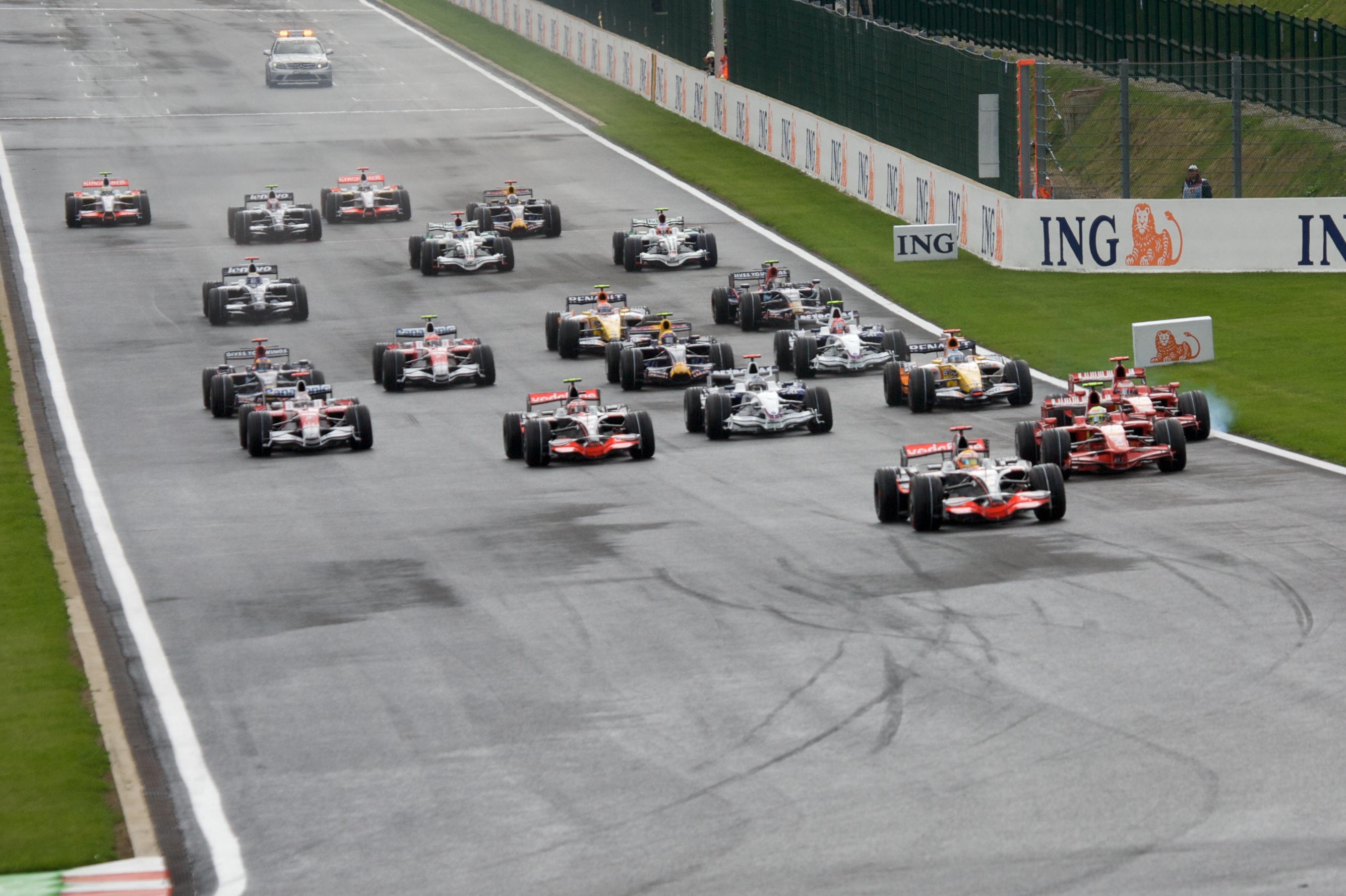
The start of the 2008 Belgian Grand Prix at Circuit de Spa-Francorchamps, one of Formula One's most competitive races. Much like today's frontier AI landscape, several leading contenders begin the race with different strengths, making the eventual winner depend on the conditions and the criteria used to judge performance. Photograph by Mark McArdle, 7 September 2008. Originally published on Flickr as A little lockup from Massa. Licensed under Creative Commons Attribution-ShareAlike 2.0 (CC BY-SA 2.0). Source: Wikimedia Commons.
Part I. Surprisingly, There Is No Clear Winner
The picture in June 2026 is surprisingly different. Independent rankings no longer identify a dominant leader. Depending on which benchmark is examined, the winner changes. Some emphasize coding, others reasoning, others realistic office work, and still others scientific problem solving. A model that finishes first on one leaderboard may place third on another.
The result is an unusual moment in the history of computing. Rather than converging toward a single dominant platform, the leading laboratories have reached remarkably similar levels of capability. Looking across today's comparisons reveals an important pattern. Every major frontier laboratory now wins somewhere. OpenAI remains exceptionally strong in research and reasoning. Google continues to lead in enormous context windows and Workspace integration. Open models continue improving at astonishing speed. Anthropic dominates many writing and coding evaluations. Perhaps the most important conclusion is that there is no longer a universally "best" AI. The race has evolved from producing the smartest model into producing the best specialist.
Different Awards for Different Strengths
Representative benchmark leaders (late June 2026)
| Capability | Leading Model(s) (June 2026) |
|---|---|
| Graduate reasoning (GPQA Diamond) | Claude |
| Agentic coding (SWE-Bench) | Claude |
| Professional writing | Claude |
| Visual reasoning (ARC-AGI 2) | GPT-5.5 |
| Mathematics (AIME 2025) | Gemini 3 Pro / GPT 5.2 |
| Multilingual reasoning (MMMLU) | Gemini 3 Pro |
| Consumer ecosystem | ChatGPT |
| Long context | Gemini |
| Professional knowledge work | Claude |
One important dimension is largely absent from these comparisons: safety. Public leaderboards generally reward capability, reasoning, coding, and benchmark performance, yet few attempt to measure how responsibly a model behaves in everyday use. Accuracy, resistance to hallucinations, privacy protections, robustness against prompt injection, and the ability to decline unsafe requests all influence whether an AI can be trusted in professional settings. Choosing a primary AI platform therefore requires looking beyond benchmark scores alone.
Taken together, the evidence suggests that the frontier has entered a new phase. Competition no longer revolves around one company establishing an insurmountable lead. Instead, innovation increasingly comes from specialization, with each laboratory refining the capabilities that best match its vision of how artificial intelligence should assist people. Recent benchmark suites illustrate that trend clearly. Claude leads several of the most demanding evaluations in graduate reasoning, agentic coding, and comprehensive knowledge tests, GPT excels in visual reasoning, and Gemini performs exceptionally well in mathematics and multilingual reasoning. Rather than identifying a single champion, the results reveal a field in which different models excel under different evaluation criteria.
Benchmark leadership, however, is not the same as platform choice. Consumers rarely choose a smartphone, operating system, or office suite by averaging dozens of technical benchmarks. Instead, they adopt the platform that best supports the work they perform most often and then build their routines around that ecosystem. Artificial intelligence is likely to follow the same pattern. Even if several frontier models remain remarkably competitive, most individuals and organizations will eventually standardize on one or two primary AI platforms. The practical question therefore shifts from Which AI wins the most benchmarks? to Which AI deserves to become my primary assistant? My answer to that question comes next.
Part II. Why My Best AI Award Goes to Claude
If I had to present a single "Best AI Award" today, I would give it to Claude. That conclusion, however, depends entirely on how the competition is judged. No single AI excels at every task, and different users naturally value different capabilities. An average consumer looking for a friendly conversational assistant, image generation, voice interaction, custom GPTs, and an intuitive interface will likely find ChatGPT the more complete platform. OpenAI has invested heavily in creating a polished ecosystem that remains the easiest recommendation for newcomers and casual users, helping explain why ChatGPT continues to dominate public awareness.
My award uses a different set of judging criteria because I spend my days evaluating artificial intelligence as a professional productivity tool rather than a consumer application. Executives, consultants, professors, lawyers, analysts, researchers, and Chief Data Officers devote far more time to preparing reports, editing presentations, reviewing policies, analyzing spreadsheets, summarizing lengthy documents, and communicating complex ideas than they do generating images or conducting voice conversations. Under those conditions, the quality of the final document matters more than the number of available features.
Judged by those standards, Claude consistently stands out. Its writing feels polished without becoming overly conversational, long documents maintain their logical structure across dozens of pages, and editing requests generally modify only the requested sections instead of rewriting an entire document. Formatting instructions are followed with remarkable consistency, making Claude particularly effective for professionals working in Microsoft Word, PowerPoint, Excel, and PDF documents. After hundreds of hours using the leading frontier models, I have increasingly found myself choosing Claude when the quality of the finished product matters most because it often produces work requiring the fewest revisions before I am comfortable sharing it with colleagues.
Recent independent comparisons reinforce that impression. One reviewer awarded ChatGPT higher marks for pricing, image generation, voice capabilities, and overall user friendliness, categories that remain central to mainstream adoption. Claude, however, received the highest ratings for writing style, document creation, browser automation, coding, and agentic workflows. Those categories closely mirror the work performed by many knowledge professionals, making the comparison particularly relevant for business, higher education, and software development.
Claude's position also appears especially strong as the industry shifts toward agentic AI. Anthropic's Claude Code has quickly become one of the most respected environments for autonomous software engineering, allowing developers to delegate substantial programming tasks while maintaining visibility into each step of the process. Rather than simply generating code snippets, Claude increasingly functions as a collaborative software engineer capable of planning, implementing, testing, debugging, and refining complex projects. That evolution broadens its appeal beyond writing and document analysis because tomorrow's professionals may spend less time prompting AI and more time supervising teams of specialized AI agents working on their behalf.
My conclusion remains a personal assessment rather than a universal ranking. Readers whose priorities center on multimodal capabilities, image generation, voice interaction, or the breadth of a consumer ecosystem may reasonably choose ChatGPT. Others deeply invested in Google's productivity suite may prefer Gemini. Judged strictly as a platform for professional knowledge work in June 2026, however, Claude earns my Best AI Award.
The broader lesson extends beyond any single company. Artificial intelligence has matured to the point where excellence has become commonplace among the leading models. Future competition will likely focus less on proving which model is the smartest and more on determining which combination of models best supports different professions and workflows. In that sense, perhaps the real winner is not Claude, ChatGPT, or Gemini, but the users who now have access to an extraordinary range of capable AI assistants, each pushing the others to improve at a remarkable pace.
Benchmarks will continue to change, and another model may top the leaderboards six months from now. Most people, however, will not switch AI platforms every time a new benchmark appears. They will choose an ecosystem that fits the way they work and build their habits around it. Judged by that standard, Claude earns my Best AI Award for professional knowledge work in June 2026.
Further Reading