Before Greek Fire
Long before Byzantine engineers perfected Greek fire, ancient Mediterranean civilizations were already experimenting with incendiary warfare at sea.
Archaeology increasingly suggests that chemistry, naval engineering, and battlefield improvisation converged centuries earlier than many historians once believed.
The ancient Mediterranean was not merely a highway for commerce. It was also a laboratory of military innovation. Across the waters of Magna Graecia, Sicily, and the wider eastern Mediterranean, warships carried more than soldiers and grain. They carried ideas, technologies, and increasingly sophisticated methods of destruction.
Marine archaeology has begun to illuminate how ancient sailors and engineers may have experimented with controlled fire long before the famous Byzantine weapon known as Greek fire emerged in the seventh century CE. Charred amphorae, scorched bronze fragments, naval rams, and burned cargo remains recovered from shipwrecks near Sicily and the Aegates Islands point toward a forgotten history of incendiary warfare. Ancient commanders understood a brutal truth: aboard wooden ships sealed with pitch and packed with rope, oil, tar, and resin, fire could become more terrifying than bronze or iron.
Greek fire occupies a near mythical place in military history because Byzantine fleets reportedly projected flaming liquid through siphons, creating a weapon that continued burning even on water. Medieval manuscripts such as the Madrid Skylitzes vividly depict Byzantine warships unleashing streams of flame against enemy fleets, preserving the psychological terror these weapons inspired across the Mediterranean world. Yet the intellectual and material foundations of such weapons likely developed much earlier.
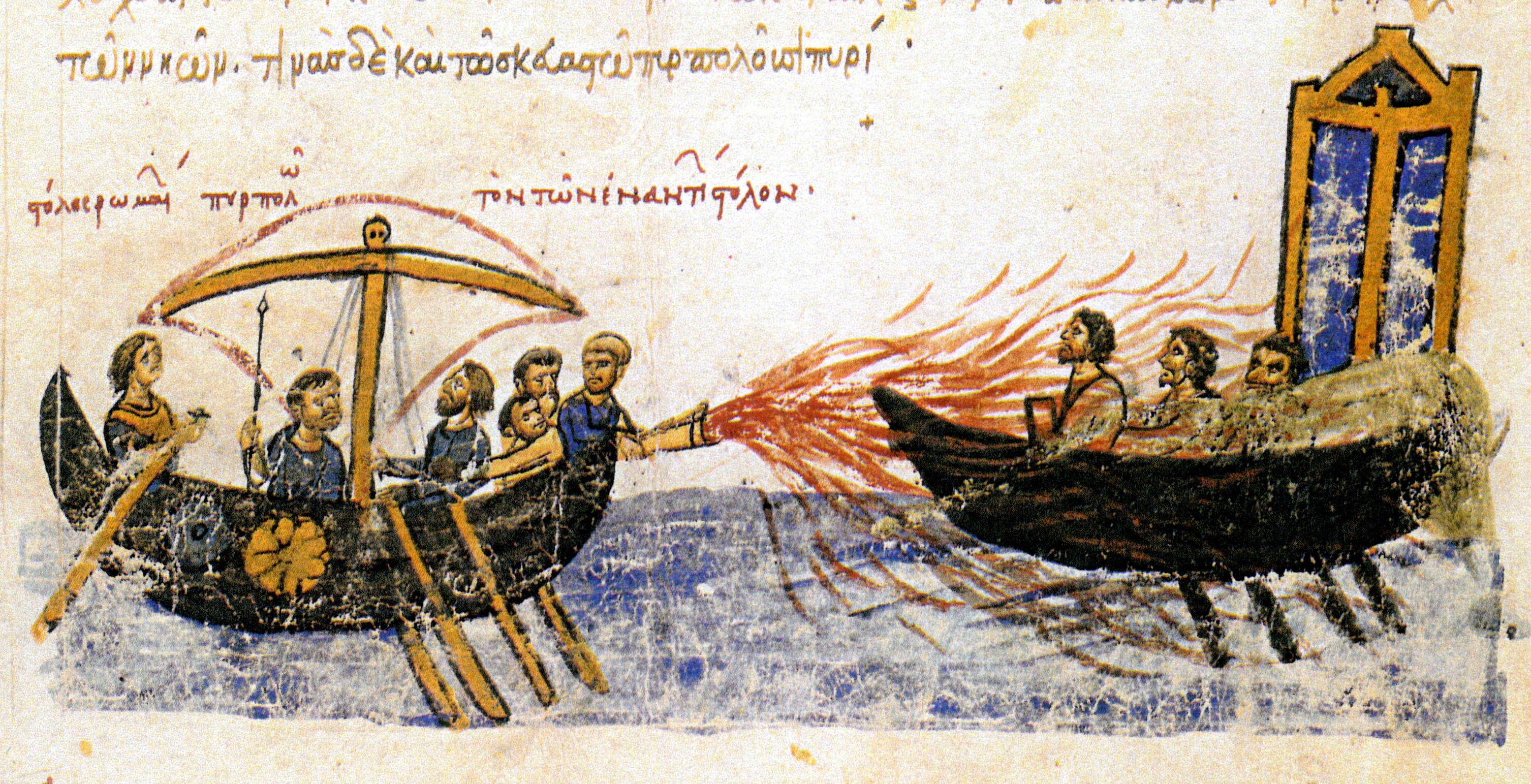
Greek fire deployed by the Byzantine fleet against the rebel forces of Thomas the Slav, from the 12th century Madrid Skylitzes manuscript. Public domain, Biblioteca Nacional de España via Wikimedia Commons.
Ancient Mediterranean societies routinely transported highly flammable substances including pine resin, sulfur, bitumen, olive oil, and pitch. Naval warfare around Sicily during the Greek, Carthaginian, and Roman periods created ideal conditions for experimentation with these compounds.
Archaeological evidence from Sicily increasingly reinforces that interpretation. Excavations tied to the Battle of the Aegates, which ended the First Punic War in 241 BCE, continue to uncover naval rams, helmets, weapons, and military debris from the seabed around the islands west of Sicily. Some recovered materials display evidence of violent burning and thermal stress, renewing scholarly discussion about whether incendiary compounds played a larger role in ancient naval combat than surviving texts describe.
Ancient historians themselves hinted at such tactics. Thucydides described the deployment of fire ships during the Peloponnesian War. Polybius documented the increasingly industrial character of Hellenistic warfare, where logistics, engineering, and chemistry began to merge into organized systems of military power. Syracuse, home of Archimedes, stood at the center of that world. Later traditions associated the mathematician with incendiary mirrors and mechanical war machines used against Roman fleets during the siege of Syracuse. Legends almost certainly magnified the reality, yet they preserved something important: ancient societies already recognized that scientific knowledge could alter the balance of war.
Modern underwater archaeology has transformed the debate because the sea preserves evidence that land rarely does. Organic cargoes, amphora residues, burned timber, fragmented hull structures, and chemical traces survive beneath sediment for centuries. Marine archaeologist Brendan Foley has argued that shipwrecks function like “telephone calls” from antiquity, preserving concentrated packets of economic, technological, and cultural information otherwise lost to history. His work in the Mediterranean and Baltic demonstrates how even ordinary cargo containers can reconstruct entire systems of trade, logistics, warfare, and scientific exchange.
Fire, Chemistry, and the Ancient Mind
Ancient incendiary warfare mattered because it represented more than battlefield improvisation. It reflected a growing scientific understanding of materials and controlled reactions. Greek natural philosophers studied combustion, mineral compounds, oils, pressure, and atmospheric behavior centuries before chemistry emerged as a formal discipline.
Many ancient substances possessed obvious military applications. Pine resin burned intensely and adhered to surfaces. Sulfur produced choking fumes. Bitumen sustained long combustion. Oil extended flame across waterlogged surfaces. Mixed together in the confined chaos of naval combat, these compounds became primitive chemical weapons. A clay jar filled with burning pitch and hurled by catapult onto a crowded deck could create panic out of proportion to its size.
Naval warfare in antiquity already demanded extraordinary engineering sophistication. Warships required advanced carpentry, metallurgy, sail design, hydrodynamic understanding, and logistical coordination across vast maritime networks. The trireme itself represented one of the most technologically advanced machines of the ancient world. Within that environment, experimentation with incendiaries appears less surprising than inevitable.
Archaeology also suggests that the ancient maritime world remains overwhelmingly undiscovered. Researchers estimate that most Mediterranean shipwrecks have never been located. Deep water exploration technologies, autonomous underwater vehicles, sonar mapping, and chemical residue analysis are now revealing evidence inaccessible to earlier generations of historians. Marine archaeologists increasingly treat the seafloor as a distributed archive of civilization, one capable of revising long accepted assumptions about technology, trade, and warfare.
Greek fire may therefore represent the culmination of a much older tradition. Byzantine engineers refined and institutionalized practices that earlier Mediterranean cultures had already begun exploring: the weaponization of chemistry at sea.
More than 90% of ancient maritime sites likely remain undiscovered beneath the Mediterranean. Each new wreck recovered from the waters around Sicily and Magna Graecia expands the historical record and complicates modern assumptions about ancient technology. Somewhere beneath layers of sediment and darkness may still rest the missing links between primitive incendiaries and the later terror of Greek fire.
Further Reading
- Greek fire and Byzantine incendiary warfare
- Brendan Foley, “Discovering History on the Ocean’s Floor,” Tufts Now
- Polybius, Histories
- Thucydides, History of the Peloponnesian War
- Battle of the Aegates underwater archaeology project
- The Marsala Punic Shipwreck