Can We Map What We Have Never Seen
A medieval diagram placed the Antarctic zone six centuries before anyone saw the continent. What separates a useful map of the unseen from a decorated one.
In late 12th-century England, someone produced a nine-folio scientific pamphlet for the instruction of monks. Folio 6v carries two diagrams of the climate zones, and the labels run around the first in order, Arctic, temperate, torrid, temperate, and then quintus cyclus Antarcticos frigidus inhabitabilis. The fifth zone, the Antarctic, cold and uninhabitable. Nobody in 12th-century England had been near it, and nobody had seen a coastline, a mile of ice, or any evidence whatsoever that the southern end of the world differed from the northern one. The zone sits on the page anyway, named and placed, more than six centuries before the first confirmed sightings of Antarctica.
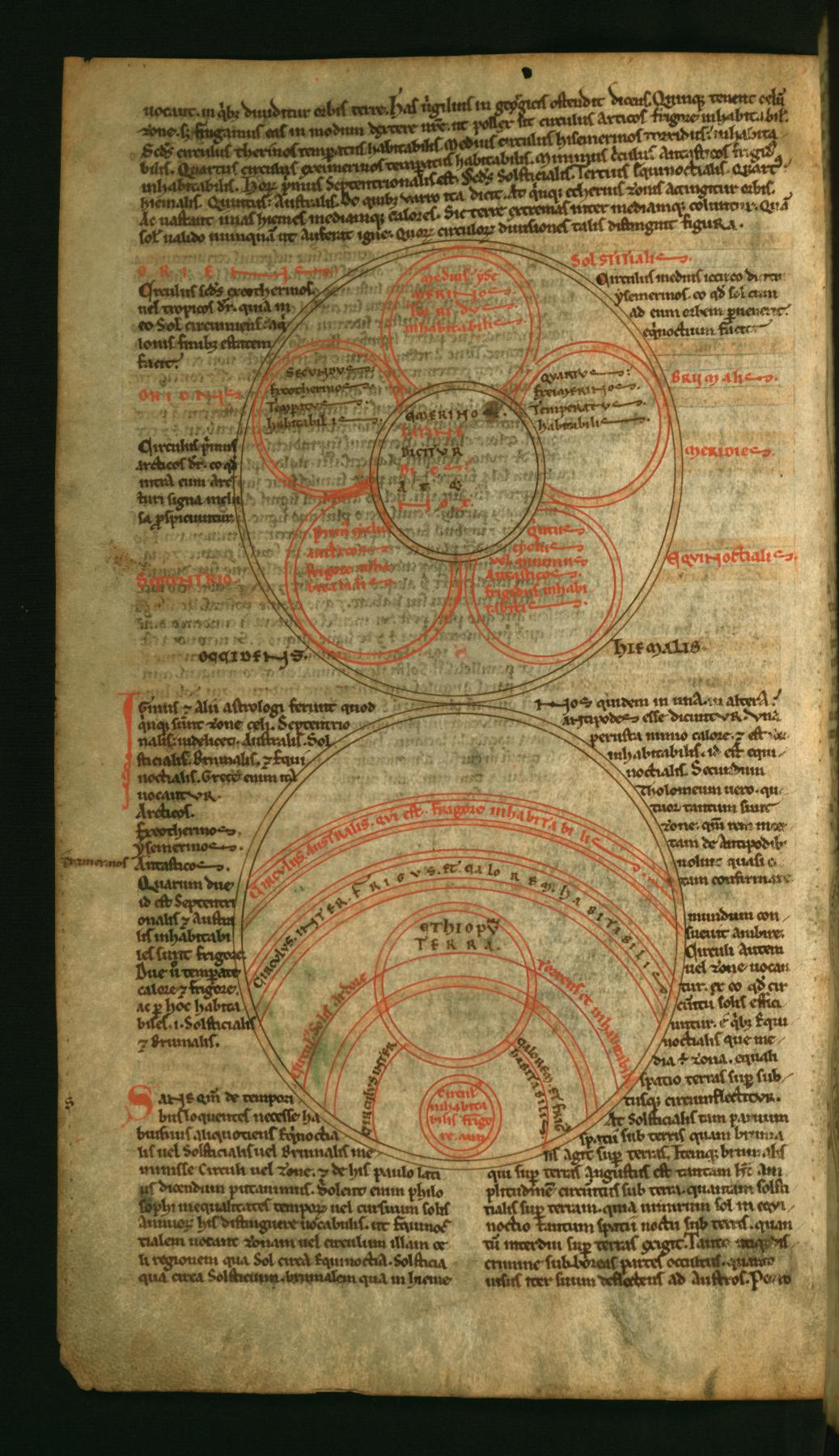 Climate zones of the heavens and the earth, from a cosmographical compendium, England, late 12th century. The Walters Art Museum, Ms. W.73, fol. 6v. Creative Commons Zero.
The drawing is not a lucky guess, and it is not a survey. It belongs to a classical and medieval tradition carried through writers such as Isidore, Bede and Abbo of Fleury, and rests on two assumptions the diagram already accepts: the Earth is a sphere, and the Sun's annual path is tilted with respect to it. Grant those, and a southern frigid band follows by the same reasoning that produces the northern one. A representation can be right about the geometry of a place and know nothing whatever about the place.
The atom was a constrained move
In the 5th century BC, Leucippus and Democritus populated the invisible world with indivisible bodies moving through void. The usual telling makes this a lucky intuition about modern chemistry, which it was not. Aristotle read early atomism as a response to a specific argument, the Eleatic claim that change and plurality are incoherent because they require something to come from what is not. Empedocles and Anaxagoras answered with persistent elemental substances. The atomists answered with unchanging particles that rearrange, and took the observed fact of motion as evidence that the void it requires exists.
Ancient atoms are not modern atoms: uncuttable by definition, differing only in shape, arrangement and position, and nothing like the divisible objects that carry their name today. The achievement is not the physics but the shape of the reasoning, an unobservable object introduced because the observable world stopped being consistent without one. The constraint did the work, and the invisible thing was what it required.
Two representations of the unseen, one of a place and one of an object, produced more than 1,500 years apart by people who could check neither. What separates the useful ones from the decorative ones is not boldness but how little freedom the author had.
The map that decorated empty space
In July 1531, the French mathematician Oronce Fine published a woodcut world map in double cordiform projection, two hearts side by side. Across the southern hemisphere he drew an enormous continent and labeled it Terra Australis recenter inventa, sed nondum plene cognita: southern land recently found, but not yet fully known. Antarctica would not be sighted until 1820.
 Oronce Fine, Noua, et integra uniuersi orbis descriptio, 1531. Library of Congress, Geography and Map Division, G3200 1531 .F5. Public domain, via Wikimedia Commons.

The resemblance has kept a small industry busy, with claims ranging from a lost ancient survey to Atlantis to visitors from elsewhere, and no evidence supports any of it. The dull explanation is sufficient: geographers had expected a large southern landmass for centuries as a counterweight to the northern continents, and the land Magellan saw to the south as he passed his strait in 1520 was read as its northern shore. Fine's map keeps that reading, leaving only a narrow channel between the tip of South America and the great continent below it.
Dismissing him is too easy, because he did put something roughly where something is. The problem is everything else on the page. The tradition constrained the existence of southern land and constrained nothing else, so it could not tell Fine the coastline, the rivers, the extent or the shape, and he supplied all of them. Set his continent against the Antarctic circle and the difference is not artistic skill or good fortune. The circle is nearly forced by two prior commitments. The continent is nearly free. The reliability of a map of the unseen depends on how little room the drawer had.
Einstein's conceptual laboratory
Writing in 1946, Einstein recalled a paradox he had hit on at 16: pursue a beam of light at the speed of light and you should see an electromagnetic field at rest but spatially oscillating, which neither experience nor Maxwell's equations allow, and he said the germ of special relativity was already in it. The story deserves its fame and a caveat that rarely travels with it. John Norton has argued the anecdote hardened into an origin myth under pressure from biographers, and that the chase, read literally, does not embarrass ether-based electrodynamics at all; he reads it against emission theories of light, which Einstein abandoned before 1905.
The other two pictures are cleaner. Two lightning strikes hit a railway line, an observer midway between them calls them simultaneous, an observer moving fast along the track does not, and simultaneity stops looking like a property of the world. Then there is the thought Einstein called the happiest of his life, in 1907 at the patent office: for an observer falling freely from a roof, in his immediate vicinity, the gravitational field does not exist. He refined the falling man into a person sealed in a chamber, unable to tell whether the floor pressing upward means gravity or acceleration, and by 1911 was using a uniformly accelerating box to derive consequences for light.
None of these is free invention, and that is the whole point of them. A thought experiment imposes principles already accepted, builds the least complicated situation in which they apply, and asks what follows until something breaks. No apparatus is needed because the constraints do the work, which is why the good ones survive being wrong about their own history. Before Einstein could calculate the new world, he had to imagine a situation in which the old one stopped making sense, and then spend eight more years on the mathematics.
Neptune, Vulcan and the price of a free parameter
Physics eventually industrialized the method and attached a price to it. Uranus refused to follow its computed orbit, Le Verrier inferred an unseen body and calculated where it should be, and on 23 September 1846, the night he received the letter, Johann Galle found Neptune within one degree of the predicted position. Thirteen years later the same man applied the same method to an unexplained advance in Mercury's perihelion and proposed an intramercurial planet that became known as Vulcan. There was no planet, and in 1915 general relativity accounted for the discrepancy, whose modern value is about 43 arcseconds per century, without adding a body to the solar system. The anomaly was real both times. In one case the missing thing was an object, and in the other the missing thing was the theory, and the method by itself could not tell Le Verrier which.
Pauli understood the exposure. On 4 December 1930 he wrote to a meeting at Tübingen, addressed them as radioactive ladies and gentlemen, and described his neutral undetectable particle as a desperate remedy to save the conservation of energy and the statistics of nuclei. He declined to publish for years, worried he had postulated something no experiment could ever reach, and confirmation took roughly 26 years. Physics did not abolish conceptual imagination or replace pictures with equations. It required every imagined object to say where to look and what would count as its refutation.
Drawing before the mathematics
The usual question about AI and discovery, whether a model can produce something absent from its training data, collapses quickly into a stale argument about memorization and recombination. The cartographic question is better. Can these systems help construct representations of intellectual territory before anyone knows how to formalize it, by proposing objects that would reconcile observations currently unconnected, or assembling situations in which several accepted assumptions cannot all hold? None of that would be discovery. It is the stage before discovery, the stage Democritus and Fine and the medieval diagrammaker were all working in.
Which is why Fine has to come back at the end. Drawing coastlines through unexplored territory used to require an engraver, a patron and a year; a model does it in a second, in confident prose, for any territory you name. Ease is the danger, because the constraint was always the expensive part and is now the only part that has not been automated. A system that can imagine the unknown is interesting. A system that can say what would prove its imagined world wrong is far more useful.
Return to the folio. A medieval scholar could place the Antarctic circle without seeing Antarctica, Democritus could populate matter with atoms he had no means to detect, Fine could draw a continent and get nearly all of it wrong, and Einstein could chase a beam of light no one can chase and find a fracture in classical physics. The common thread is not prediction but representation, and human beings keep building models of worlds that experience has not yet reached. The task was never to imagine past the known. The task is to constrain imagination until reality gets a vote. Perhaps the next serious use of these systems is not answering questions about territory already mapped, but helping draw the first uncertain outlines of territory for which we do not yet have the mathematics.
Further Reading
- Walters Ms. W.73, Cosmography - The Digital Walters. Full curatorial description and transcription of the zone labels, including the Antarctic zone. Object page for fol. 6v at art.thewalters.org.
- Sylvia Berryman, Ancient Atomism, Leucippus and Democritus - Stanford Encyclopedia of Philosophy. Source for atomism as a response to the Eleatic argument and for the limits of the comparison with modern atomic theory.
- Oronce Fine, Noua, et integra uniuersi orbis descriptio - Library of Congress, Geography and Map Division.
- Review of John G. Weihaupt, The Mysterious Discovery of Antarctica, in Arctic - on Fine's southern continent as a continuation of Magellan's Tierra del Fuego, and on the narrow strait separating it from South America.
- John D. Norton, Chasing the Light: Einstein's Most Famous Thought Experiment - University of Pittsburgh. The revisionist reading of the light beam story, and Einstein's Pathway to Special Relativity for the surrounding sequence.
- September 23, 1846: Neptune's Existence Observationally Confirmed - American Physical Society.
- Clifford M. Will, The Confrontation between General Relativity and Experiment - on the Mercury perihelion anomaly and the failure of the Vulcan hypothesis.
- Dear Radioactive Ladies and Gentlemen - Duke HEP Neutrino Group. Translation of Pauli's letter of 4 December 1930.
AI Assistance Statement ▾
This blog publishes at a near daily rate, and that pace is possible because AI tools do a substantial share of the work between the idea and the published text. Preparation of this entry included assistance from Anthropic's Claude and from OpenAI's ChatGPT (GPT-5 series reasoning models). I use them to research a topic and gather primary sources, to organize ideas and propose structure, to draft and revise prose, to check factual claims against the cited sources before publication, and to score drafts against a set of house style rules. Longer pieces are often developed across several sessions. A written handover carries the argument, sources, and open questions from one session to the next, and the same tools help prepare those handovers. The tools also help identify candidate images and confirm that selected images appear to be released for reuse, for example through public domain or Creative Commons licensing.
The process is also an AI experiment in its own right. There is a live argument about what AI-assisted writing does to originality, and whether the result is thought or slop; the August 2026 dispute over a Wall Street Journal op-ed that its author acknowledged drafting with AI, and the Journal's subsequent defense of the practice (WSJ is behind a paywall, but for a good public summary: click here), is one newsworthy example. I would rather run the experiment openly than pretend it is not happening. This blog is one sustained attempt to find out whether a person with an argument, working with these tools every day, produces writing that is still recognizably that person's, and I disclose the method so readers can judge the result.
The judgment is mine. I choose the topic, decide the argument, supply the personal and professional experience the pieces draw on, read and edit every draft, verify the sources and image licensing, and take full responsibility for the final published content. Where a post contains my own recollections, the AI did not invent them.
For a detailed account of how these posts are researched, drafted, scored, revised, and published, see My AI Experiment: How I Write This Blog.
Statement revised September 2026.