Colonel Elmer?!
A visit to Pittsburgh’s Soldiers & Sailors Memorial Hall revealed how architecture, artifacts, and personal stories preserve the nation’s military heritage.
During my recent visit to Pittsburgh for Carnegie Mellon's Chief Data and AI Officer Executive Program graduation, I found time to explore one of the city's overlooked treasures: Soldiers & Sailors Memorial Hall & Museum.
 Exterior of Soldiers & Sailors Memorial, Pittsburgh. Designed by architect Henry Hornbostel and completed in 1910, the memorial was inspired by the Mausoleum at Halicarnassus, the monumental fourth-century BCE tomb of Mausolus in ancient Caria (modern Türkiye), celebrated as one of the Seven Wonders of the Ancient World. Elmer Yglesias (2026).
From the outside, the building feels less like a museum than a modern Greek temple. Massive Corinthian columns rise above the entrance, while the broad stone façade reminds visitors that remembrance deserves monumental architecture. Built to honor Civil War veterans, the memorial has grown into something much larger, preserving the stories of Americans who served from the nineteenth century through the present day.
Inside, the magnificent Memorial Auditorium immediately commands attention. Beneath its richly ornamented ceiling, Abraham Lincoln's Gettysburg Address stretches across the stage, transforming what could have been an ordinary performance hall into a civic sanctuary dedicated to service and sacrifice.
 Memorial Auditorium, Pittsburgh. Designed by Henry Hornbostel and opened in 1910, it was intended for patriotic ceremonies, veterans' reunions, public lectures, concerts, civic gatherings, and educational events rather than military displays alone. Above the 78-foot stage hangs the largest known hand-painted canvas reproduction of Abraham Lincoln's Gettysburg Address. Elmer Yglesias (2026)
As I entered the Civil War gallery, an old habit took over.
Having an uncommon first name has one advantage: every Elmer in history demands my attention. It has become a Forrest Gump game of sorts... Colonel Elmer Ellsworth was no exception.
A large exhibit recounted the remarkable story of the young Union officer. At only twenty four years old, Ellsworth had already become one of Abraham Lincoln's closest young companions. Before the Civil War, he worked in Lincoln's Springfield law office, earning the admiration and friendship of both Abraham and Mary Lincoln.
When Union forces entered Alexandria, Virginia, in May 1861, one object immediately drew Lincoln's attention. A massive Confederate flag flew from the Marshall House Inn, visible across the Potomac from the White House itself. Lincoln reportedly found the sight deeply offensive.
Ellsworth decided the flag had to come down.
He climbed to the roof, removed the Confederate banner, folded it under his arm, and began descending the stairs. Before reaching the ground, the inn's owner, James Jackson, shot him at point blank range with a shotgun. Ellsworth became the first Union officer killed in the Civil War. Lincoln was devastated. The young colonel lay in state in the East Room of the White House, where thousands came to pay their respects. His death became one of the Union's earliest rallying cries.
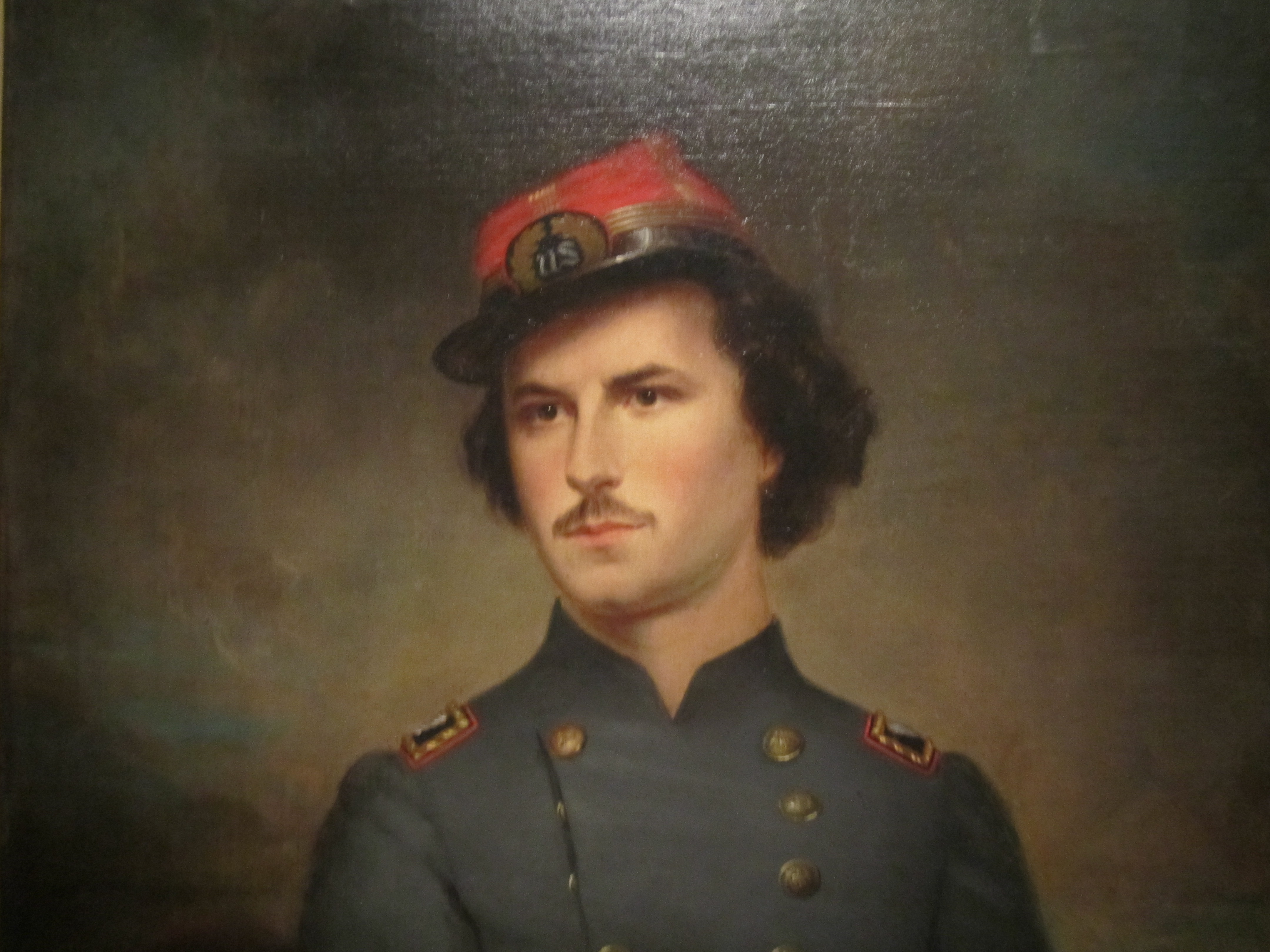 Unknown artist, after a photograph by Mathew Brady, Portrait of Elmer Ellsworth, displayed at the Smithsonian National Portrait Gallery, Washington, D.C. Photograph by Billy Hathorn, 29 July 2011. Image available via Wikimedia Commons under the Creative Commons CC0 1.0 Universal Public Domain Dedication. The underlying nineteenth-century portrait is in the public domain; the photographic reproduction has been dedicated to the public domain (CC0) by the photographer.
The museum's greatest strength, however, is that it balances famous figures with ordinary stories.
Nearby stood the story of Dog Jack, the stray bulldog who marched with Pennsylvania soldiers through battle after battle, survived captivity, escaped, recovered from wounds, and faithfully remained with his regiment.
 Dog Jack, the beloved mascot of the 102nd Pennsylvania Volunteer Infantry, marched with Union soldiers through numerous Civil War campaigns, survived wounds, Confederate capture, and escape, becoming a symbol of loyalty and resilience. Exhibit at Soldiers & Sailors Memorial Hall & Museum, Pittsburgh, Pennsylvania. Photograph by Elmer Yglesias, 2026.
A worn D-Day jump jacket carried the marks of combat more convincingly than any statistics, while a hand painted B-24 flight jacket silently recorded completed bombing missions.
 This M1942 jump jacket was worn by Pvt. Paul Swazuk of the 82nd Airborne Division during the D-Day landings on June 6, 1944. Its oversized cargo pockets and rugged construction influenced generations of field jackets, with modern brands such as Belstaff still reflecting many of the same functional design principles. Exhibit at Soldiers & Sailors Memorial Hall & Museum, Pittsburgh, Pennsylvania. Photograph by Elmer Yglesias, 2026.
 This hand-painted A-2 flight jacket was worn by a U.S. Army Air Forces airman assigned to the B-24 Liberator Lady Luck, with the artwork serving as both a personal keepsake and a visual record of wartime service. During World War II, bomber crews often decorated their jackets with aircraft names, nose art, squadron insignia, and mission symbols, transforming standard issue gear into deeply personal expressions of identity, pride, and survival. A-2 Flight Jacket, "Lady Luck", U.S. Army Air Forces, World War II. Exhibit at Soldiers & Sailors Memorial Hall & Museum, Pittsburgh, Pennsylvania. Photograph by Elmer Yglesias, 2026.
A canvas flight bag decorated with Donald Duck and a display explaining how Cracker Jack manufactured packaging for Army K-rations during World War II reminded me that wars are fought not only by those on the battlefield, but also by the countless people and industries supporting them at home.
 This canvas flight bag, decorated with Walt Disney's Donald Duck, belonged to a U.S. Army Air Forces serviceman during World War II. Cartoon characters and hand-painted artwork transformed ordinary military equipment into personal keepsakes, boosting morale while reflecting the individuality of the men who carried them. Donald Duck Flight Bag, U.S. Army Air Forces, World War II. Exhibit at Soldiers & Sailors Memorial Hall & Museum, Pittsburgh, Pennsylvania. Photograph by Elmer Yglesias, 2026.
 During World War II, the Cracker Jack Company adapted its packaging expertise to manufacture components for U.S. Army K-rations, illustrating how American industry mobilized in support of the war effort. The exhibit reminds visitors that victory depended not only on those serving overseas, but also on the factories and workers who supplied them. Cracker Jack and the World War II War Effort, exhibit at Soldiers & Sailors Memorial Hall & Museum, Pittsburgh, Pennsylvania. Photograph by Elmer Yglesias, 2026.
That is what makes Soldiers & Sailors Memorial Hall such an exceptional museum. Rather than telling the story of war through weapons alone, it tells the story through people.
As I made my way toward the exit, I looked through an open doorway and found what may have been the museum's most important exhibit. A group of students sat listening as a museum educator explained uniforms, equipment, and the experiences of American servicemen. The artifacts were no longer objects behind glass. They had become teaching tools.
 Museum educators introduce students to the uniforms, artifacts, and personal stories that bring more than a century of American military history to life. By connecting original objects with the experiences of the men and women who served, they ensure that remembrance becomes understanding for the next generation. Museum Education Program, Soldiers & Sailors Memorial Hall & Museum, Pittsburgh, Pennsylvania. Photograph by Elmer Yglesias, 2026.
Museums like this do more than preserve history. They provide context that textbooks alone cannot. Standing beneath Lincoln's Gettysburg Address, learning about Colonel Elmer Ellsworth, examining a D-Day jump jacket, or discovering how something as ordinary as a box of Cracker Jack contributed to the war effort makes the past tangible in ways that dates and timelines never can.
I arrived expecting an impressive military museum. I left convinced that Soldiers & Sailors Memorial Hall is one of those rare places where preservation and education meet. Its staff, volunteers, and educators ensure that each generation encounters not just artifacts, but the people behind them. Colonel Elmer first caught my attention, but the museum's commitment to telling the broader American story is what will bring me back.
Further Reading
- Soldiers & Sailors Memorial Hall & Museum. Official Website
- Smithsonian National Portrait Gallery. The Death of Elmer Ellsworth.
- Elmer Ellsworth