I Love Dirty Dr. Pepper. McDonald's Loves It Too.
A simple Dirty Dr Pepper reveals how restaurant chains are using analytics, customization, and premium pricing to transform beverages into one of the most important growth engines in the food industry.
A Dirty Dr Pepper may seem like an unlikely lens through which to examine the modern restaurant industry. Yet the remarkable growth of specialty beverages reveals a much larger story. Across the United States, chains ranging from McDonald's to Sonic to Sheetz are investing heavily in flavored sodas, refreshers, energy drinks, and other premium beverages. The trend reflects more than changing tastes. It reveals a broader transformation in consumer behavior, product development, and restaurant strategy, one that may ultimately prove more significant than the latest burger or chicken sandwich.
A few weeks ago, I found myself ordering a McDonald's Dirty Dr Pepper. Somewhere between the coconut syrup, lime, and familiar Dr Pepper flavor, I realized I was paying almost as much for a beverage as I once paid for an entire fast-food meal. The drink was undeniably enjoyable, which may explain why I keep ordering it, but it also raised a broader question. Why have restaurant chains suddenly become so obsessed with specialty beverages, and why are consumers increasingly willing to pay premium prices for them?
The phenomenon is difficult to miss. Sonic regularly introduces colorful limited-time beverages, including patriotic offerings such as its America 250 drink. Starbucks continues to expand its Refreshers platform. McDonald's has rolled out flavored sodas, refreshers, and cold brews inspired by its CosMc's experiment. Even convenience store chains such as Sheetz have invested heavily in beverage innovation. Products that would have been considered niche curiosities only a few years ago have become a central feature of restaurant menus across the country. Industry analysts estimate that dirty soda menu penetration is growing at roughly 42% annually, a remarkable figure for a category that barely registered nationally a few years ago.
At first glance, the trend appears counterintuitive. For decades, beverages occupied a supporting role in the fast-food business. Customers visited restaurants for hamburgers, chicken sandwiches, tacos, or pizza, and drinks accompanied those purchases almost as an afterthought. Today, customers increasingly make dedicated trips for beverages, treating them as affordable indulgences and daily rituals. What appears to be a simple trend in flavored drinks is actually part of a much larger transformation in how restaurants think about growth.

A dirty soda combines a traditional soft drink with flavored syrups, creamers, and other add-ins, creating a beverage that blurs the line between soda, dessert, and specialty coffee. The rapid growth of products like these has helped fuel a beverage boom that is reshaping the economics of the restaurant industry. Image: "Dirty Coke" by Lolly Jane (2024), via Wikimedia Commons. Licensed under CC BY 3.0. Original source: https://www.youtube.com/watch?v=1eV3S6u7m3w
CosMc's and the Science of Beverage Innovation
One of the most revealing clues about the future of the restaurant industry emerged from an unusual experiment launched by McDonald's in late 2023. The company introduced CosMc's, a beverage-focused chain named after an obscure alien character from McDonaldland who briefly appeared in advertising during the 1980s. To many observers, the concept appeared unusual, even whimsical. The menu emphasized refreshers, flavored sodas, energy drinks, cold brews, specialty lemonades, and highly customizable beverages rather than the burgers and fries typically associated with the McDonald's brand.
The first CosMc's location opened in Bolingbrook, Illinois, a suburb of Chicago. Additional locations soon appeared in Texas, primarily around the Dallas-Fort Worth and San Antonio markets. The restaurants attracted significant attention from customers and the media. Long lines formed during the opening weeks, and the unusual menu generated widespread discussion across social media platforms. To outside observers, CosMc's looked like McDonald's attempt to compete directly with Starbucks, Dutch Bros, and the growing number of specialty beverage chains emerging across the country.
The reality was considerably more ambitious.
CosMc's functioned as a large-scale laboratory for consumer behavior. McDonald's executives understood that specialty beverages represented one of the fastest-growing categories in food service, but they also recognized that introducing highly customized drinks directly into thousands of traditional restaurants carried operational risks. Every additional flavor, syrup, topping, and customization option increases complexity. A mistake repeated across a handful of test locations is manageable. A mistake repeated across more than 13,000 restaurants becomes very expensive.
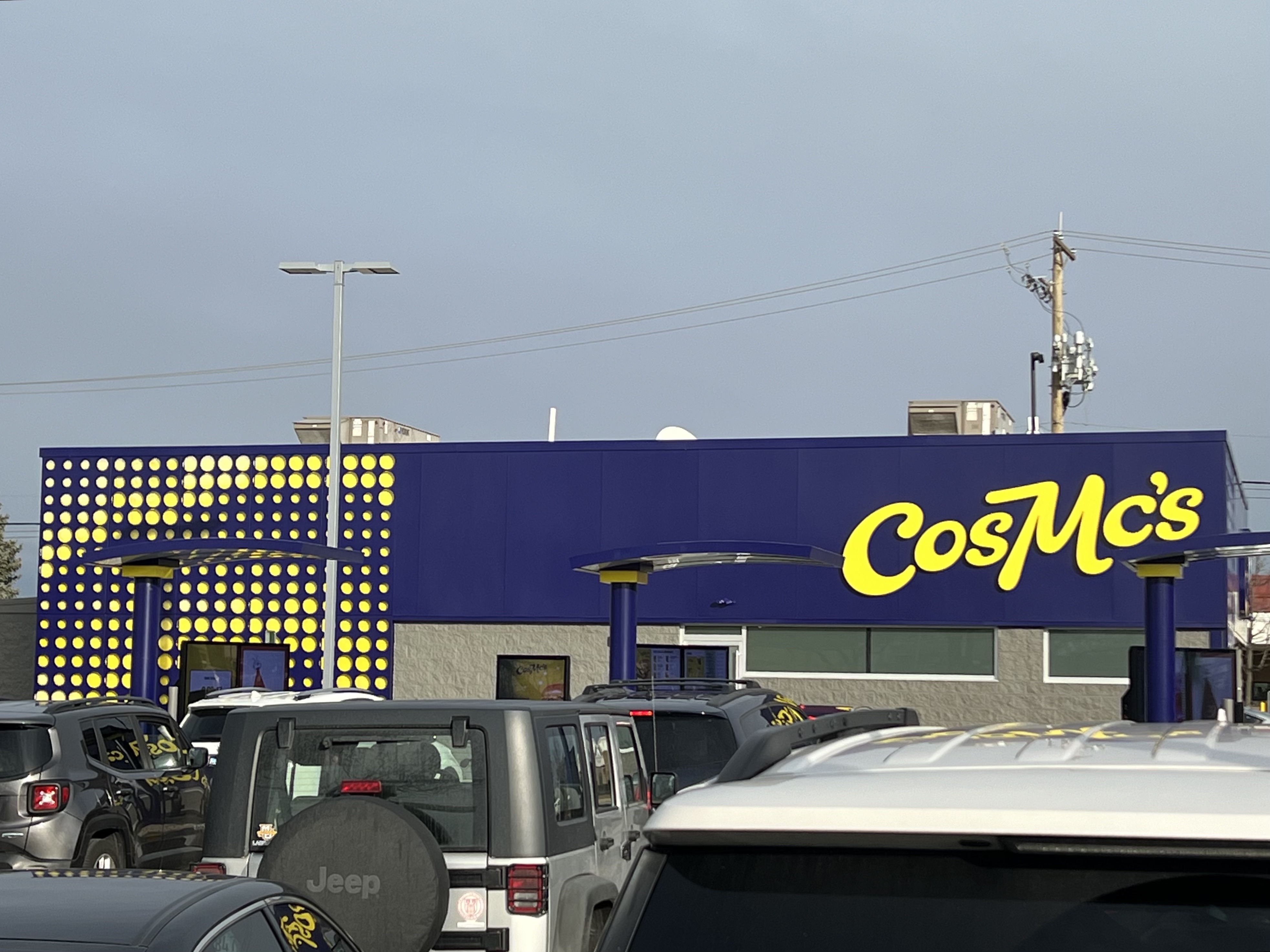
McDonald's first CosMc's location in Bolingbrook, Illinois. The beverage-focused concept served as a testing ground for new drinks, customization options, and customer preferences before many products migrated to traditional McDonald's restaurants. Image: "CosMc's Bolingbrook" by BanjoZebra (2023), via Wikimedia Commons. CC0 1.0 (Public Domain).
CosMc's provided a controlled environment in which those questions could be explored. Every transaction generated data about flavor preferences, customization patterns, pricing tolerance, repeat purchasing behavior, and operational challenges. The stores allowed McDonald's to experiment with products and technologies that would have been difficult to test within the traditional McDonald's system.
From an analytics perspective, the experiment was remarkably sophisticated. Executives were not merely asking which beverage tasted best. They were evaluating which products generated repeat visits, which customization options customers selected most frequently, which beverages commanded premium pricing, and which combinations could be prepared efficiently at scale. They were measuring service times, customer satisfaction, and average transaction values. They were studying whether customers responded more strongly to refreshers, energy drinks, flavored sodas, or cold brews. Perhaps most importantly, they were attempting to understand whether beverages could become destinations in their own right rather than simply companions to a meal.
That final question may have been the most valuable of all. Traditional fast-food economics revolve around meal occasions. Customers become hungry and visit a restaurant. Specialty beverages create an entirely different consumption pattern. A customer may stop for a flavored soda in the afternoon, a refresher after work, or a cold brew during a commute without purchasing any food. Every one of those visits represents new revenue rather than revenue attached to a meal. For a company serving millions of customers each day, even a modest increase in beverage-focused visits can translate into a substantial new revenue stream.
The menu itself reflected this experimental mindset. Customers could customize drinks with flavor shots, energy boosts, vitamin additives, fruit inclusions, popping boba, and a growing assortment of seasonal options. Some beverages resembled products found at coffee chains. Others looked more like creations from specialty soda shops or bubble tea stores. The goal was not simply to sell drinks. The goal was to discover which combinations resonated with consumers and which could be scaled profitably.
Although the standalone CosMc's locations ultimately closed, the experiment itself appears to have succeeded. McDonald's later described the concept as a learning laboratory and announced plans to incorporate many of the beverages and operational lessons into hundreds of traditional restaurants. In effect, the company determined that the information gathered through CosMc's was more valuable than maintaining a separate chain. What appeared to be a quirky side project was actually one of the largest beverage-market research efforts ever undertaken by a restaurant company.
Competitors quickly noticed the implications. If one of the world's largest restaurant companies was willing to build an entire chain simply to study beverage behavior, something important was happening. The race to create the next successful drink was no longer a marketing exercise. It had become a data-driven search for the next major growth engine in fast food.
The Great Beverage Arms Race
The response has been visible across the industry. Starbucks continues expanding Refreshers after building a business that the company has valued at approximately $2 billion annually. Sonic has embraced increasingly elaborate limited-time beverages, including patriotic promotions such as the America 250 drink. Sheetz has expanded its drink menu with frozen beverages, refreshers, energy drinks, and highly customizable options. What began as isolated experimentation has evolved into an industry-wide competition.
The sheer variety of products now available would have been difficult to imagine only a decade ago. Consumers can choose from dirty sodas, refreshers, flavored lemonades, energy beverages, mocktails, frozen drinks, cold brews, smoothies, bubble teas, and hybrid products that blur traditional category boundaries. New flavors appear constantly. Seasonal launches arrive with increasing frequency. Limited-time offerings generate urgency and social media attention before disappearing and making room for the next innovation.
The rise of dirty sodas illustrates how rapidly a niche concept can become a national phenomenon. Popularized in Utah and amplified through social media, the concept combines familiar soft drinks with flavored syrups, fruit additions, creamers, and other enhancements. The result feels less like a traditional soda and more like a dessert, mocktail, or specialty coffee drink. Consumers are not simply purchasing carbonation and sweetener. They are purchasing an experience, a flavor combination, and a small moment of indulgence.
Social media has accelerated this evolution. Industry observers estimate that social media discussion of dirty sodas has increased by roughly 270% in recent years, helping transform a regional curiosity into a national trend. A hamburger generally looks like a hamburger. A brightly colored beverage with layered flavors, fruit garnishes, flavored creams, or seasonal branding photographs far more effectively. Platforms such as Instagram and TikTok reward visual novelty, encouraging companies to create products designed to generate attention beyond the restaurant itself. Beverage innovation therefore functions as both a revenue strategy and a marketing strategy.
The language used to market these products also reveals how the category has evolved. McDonald's describes its Sprite Berry Blast as "overflowing with electric personality for your yap-sessions." Such phrasing would have been unthinkable in traditional soda advertising. Modern specialty beverages are marketed less as refreshments and more as experiences, accessories to social interaction, and expressions of personal identity.
The pace of innovation increasingly resembles the technology sector more than the restaurant business. Companies release products, gather customer data, measure engagement, and iterate rapidly. Flavor development has become a continuous process rather than an occasional menu update.
Why Drinks Beat Food
The economics behind the trend help explain why so many companies are investing heavily in beverages. Yet the emerging beverage economy is more complex than a simple story of higher prices. Restaurants have effectively created a new pricing ladder, with products ranging from low-cost promotional beverages to premium refreshers and energy drinks that approach the cost of a meal.
Sample Beverage Prices (June 2026)
| Beverage | Chain | Price |
|---|---|---|
| Red, White & Blue Slush Float* (Large) | Sonic | $2.50 |
| Dirty Dr Pepper (Large) | McDonald's | $3.99 |
| Sprite Berry Blast (Large) | McDonald's | $3.99 |
| Strawberry Passionfruit Refresher (Large) | Sonic | $4.69 |
| Butterfly Drink (Large) | Starbucks | $7.45 |
| Tropical Butterfly Energy Refresher (Large) | Starbucks | $8.20 |
*Limited-time promotional beverage associated with Sonic's America 250 campaign.
The observed prices reveal a surprisingly sophisticated market structure. Specialty beverages no longer occupy a single category. Instead, they span multiple tiers, from limited-time promotional products to premium refreshers and energy beverages approaching eight dollars. The result is a beverage market with a pricing structure that increasingly resembles a restaurant menu of its own.

A Sonic Drive-In restaurant, one of several chains expanding aggressively into premium beverages, refreshers, and limited-time drink promotions. Image: Mike Mozart (2014), via Wikimedia Commons. Licensed under CC BY 2.0.
The Sonic America 250 Slush Float appears to be priced differently from many premium beverages because it functions as a limited-time promotional product. Such offerings often prioritize seasonal traffic, social media engagement, and brand visibility over maximizing margins. Excluding that promotion, the beverages examined for this article cluster around a $4 to $8 price point.
| Beverage Type | Typical Price | Premium Versions | Relative Profit Potential* |
|---|---|---|---|
| Fountain Soda | $1.50–$3.00 | Standard fountain drinks | Very High |
| Dirty Soda | $4.00–$7.00 | Coconut cream, syrups, lime | Extremely High |
| Refresher | $4.00–$7.00 | Boba, fruit inclusions, energy boosts | Extremely High |
| Frozen Beverage | $4.00–$8.00 | Candy, syrups, toppings | Very High |
| Cold Brew | $3.00–$7.00 | Cold foam, flavor shots | Very High |
| Energy Drink Creation | $4.00–$8.00 | Energy boosts, flavor shots | Extremely High |
| Smoothie | $5.00–$10.00 | Protein, supplements, extra fruit | High |
| Bubble Tea | $5.00–$9.00 | Boba, jellies, creams | Very High |
| Specialty Coffee | $4.00–$8.00 | Alternative milks, syrups, cold foam | Very High |
*Illustrative comparison based on likely restaurant economics, ingredient costs, labor requirements, and customization opportunities.
Traditional food items are expensive to produce. A hamburger requires beef, bread, vegetables, cheese, packaging, cooking equipment, and substantial labor. Specialty beverages often rely primarily on water, ice, carbonation, syrups, flavorings, and a comparatively simple preparation process. Although exact margins vary by company and product, industry observers routinely identify premium beverages as among the most profitable items on restaurant menus.
The economics become even more attractive when customization enters the equation. Adding coconut syrup, flavored cream, fruit concentrates, cold foam, fruit inclusions, or an energy boost changes the consumer's perception of the product far more than it changes the underlying cost structure. Each additional customization increases perceived value while adding relatively little cost. A beverage that begins as an inexpensive fountain drink can quickly become a premium product commanding several times the original price.
Consumer psychology reinforces the model. During periods of economic uncertainty, people often continue spending on relatively inexpensive luxuries even as they postpone larger discretionary purchases. A six-dollar beverage feels affordable compared with a restaurant dinner, a vacation, or a major retail purchase. Specialty beverages therefore occupy a unique position in the marketplace, functioning simultaneously as refreshments, treats, and lifestyle products.
Generational changes may also be contributing to the trend. Younger consumers generally consume less alcohol than previous generations, creating opportunities for premium nonalcoholic alternatives that still deliver novelty, customization, and social appeal. Many specialty beverages serve some of the same social and experiential functions that cocktails once occupied, but without the alcohol.
Environmental factors may reinforce the trend as well. Much of the United States is experiencing hotter summers and more frequent periods of extreme heat than previous generations. Those conditions naturally increase demand for cold beverages and may create additional opportunities for restaurants to market refreshers, frozen drinks, flavored sodas, and other products designed for warm-weather consumption. Climate alone does not explain the rise of specialty beverages, but a hotter world may provide a favorable backdrop for continued growth.
The health implications remain uncertain. Many specialty beverages contain substantial amounts of sugar and calories, leading some nutrition experts to question whether consumers are genuinely moving away from unhealthy soft drinks or merely consuming more elaborate versions of them. A large McDonald's Sprite Berry Blast, for example, contains 390 calories, roughly double the calories of a standard Sprite or Dr Pepper. The industry's enthusiasm for beverage innovation may therefore continue to collide with broader concerns about nutrition and public health.
Where This Is Going
Advances in analytics may push the trend even further. Restaurant companies now collect enormous quantities of customer data through loyalty programs, mobile applications, and digital ordering platforms. Those systems make it possible to identify emerging flavor preferences, test products rapidly, and target promotions with increasing precision. Future beverage menus may become even more personalized, with recommendations tailored to individual purchasing histories, regional tastes, weather conditions, and seasonal preferences.
The larger implication is that beverages are no longer supporting players in the restaurant business. They are increasingly becoming a primary engine of growth. Specialty beverages offer attractive margins, support frequent purchases, generate social media engagement, and create entirely new visit occasions. Few other restaurant categories can claim all four advantages simultaneously.
America did not stop paying premium prices for drinks after Starbucks. The rest of the restaurant industry decided to join Starbucks.
The next major battle in fast food may not be fought over hamburgers, chicken sandwiches, or french fries. It may instead revolve around refreshers, dirty sodas, energy drinks, flavored cold brews, and a growing collection of products that would have seemed unusual only a few years ago. What began as a simple curiosity about a Dirty Dr Pepper ultimately reveals something much larger: a fundamental shift in how restaurant companies create value, attract customers, and pursue growth in an increasingly competitive marketplace.
My favorite drink remains the Dirty Dr Pepper. After learning the economics behind it, I also understand why McDonald's built an entire restaurant chain to study customers like me.
Further Reading
- The Rise of Dirty Soda
- McDonald's Welcomes CosMc's to Its Universe
- How Starbucks Built a $2 Billion Refreshers Business