Eyes Without a Face
Why modern robots stopped trying to smile.
Faceless Humanoids
Modern robotics has quietly made a choice. It no longer tries to reproduce the human face. Across the most advanced systems today, a pattern emerges. None of them have faces.
Robots developed by Boston Dynamics demonstrate extraordinary mobility and coordination without any attempt at human likeness. Their machines are immediately recognizable as machines, and that clarity supports their function.
Humanoid systems from Figure AI retain the human form but remove identity. The body remains. The face does not. Expression is reduced to a neutral surface, avoiding any suggestion of personality.
At the same time, Unitree Robotics produces capable systems designed for scale. These robots make no attempt at resemblance. They are direct, efficient, and unambiguous.
Different companies, different constraints, the same outcome. The human face has been set aside.
From Imitation to Restraint
Earlier efforts pursued a different path. Systems such as Repliee Q2 attempted to replicate human appearance as closely as possible. The goal was fidelity.
Design has since adjusted. Rather than closing the gap between machine and human, modern systems maintain it. The result is more effective interaction. A robot that clearly signals what it is does not create confusion or expectation. It does not promise what it cannot deliver.
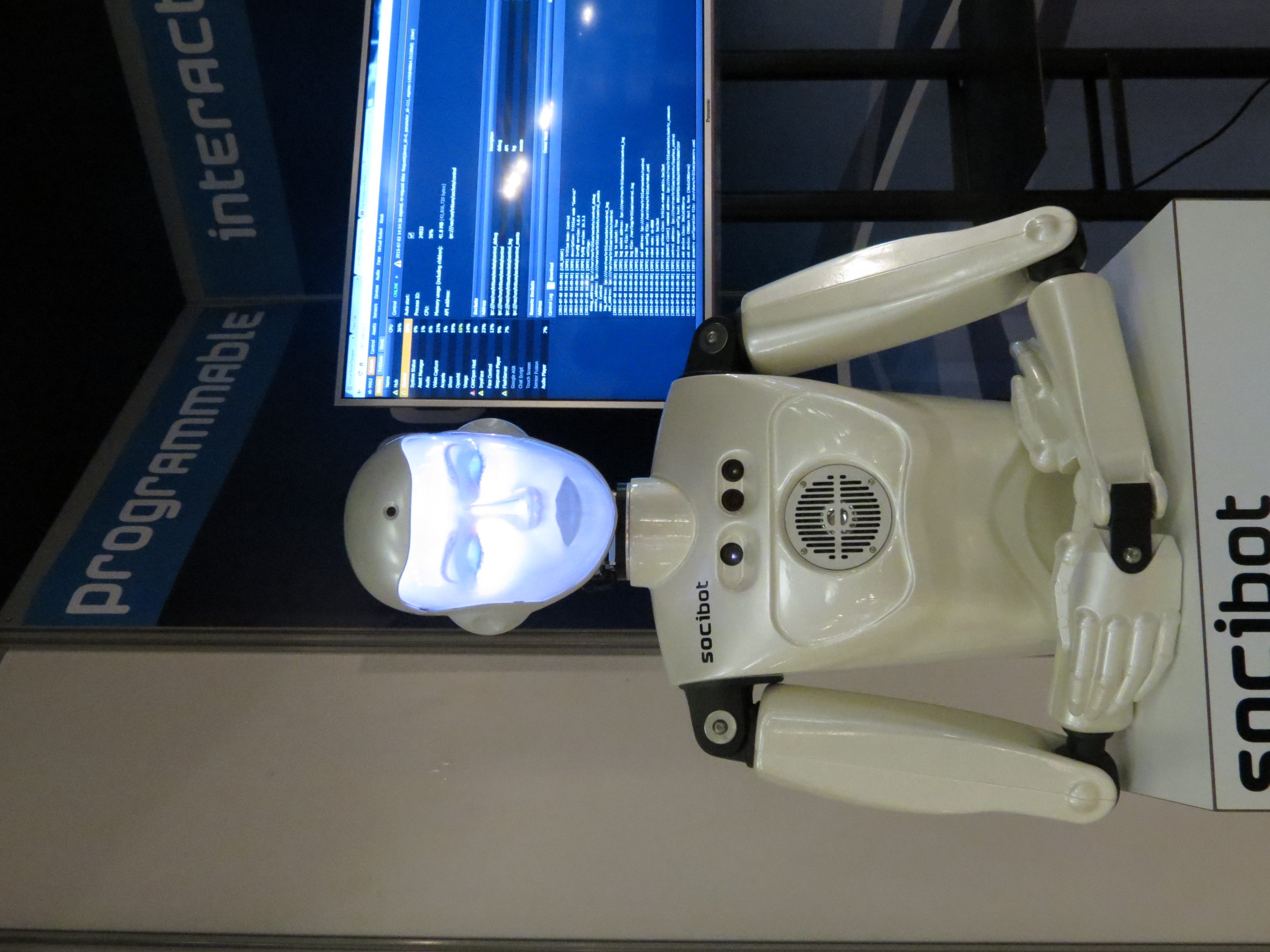
Socibot humanoid robot by Engineered Arts at Innorobo 2015. Image by Scailyna, used under Creative Commons Attribution-ShareAlike 4.0 (CC BY-SA 4.0).
However, a few groups continue to explore human-like faces. Engineered Arts has developed systems capable of highly expressive facial movement, where subtle shifts in muscle-like actuators produce remarkably lifelike expressions. These robots can smile, frown, and track attention in ways that closely mirror human behavior. Such work demonstrates that the technical barrier has largely been overcome. Engineers can now replicate facial motion with precision, and the challenge has shifted from mechanics to perception.
These systems are typically presented in controlled environments such as exhibitions, research labs, and staged demonstrations, where audiences expect performance and spectacle. In those settings, the human-like face becomes part of the experience rather than a requirement for function. Outside those environments, the calculus changes. A face invites interpretation, suggesting emotion, intention, and awareness. When those expectations are not fully met, even slight imperfections can become unsettling, and the closer the resemblance, the greater the risk.
For that reason, these efforts explore possibility rather than define practice. They serve as a boundary case, showing what can be done, not necessarily what should be deployed. At scale, robotics has already chosen a different direction.
The Missing Element
The pattern is not incidental; it reflects a deeper constraint. The shift is not a retreat from ambition but a recognition of the Uncanny Valley and the limits it imposes. Movement, perception, and decision-making can be engineered, measured, and steadily improved. Appearance operates under a different set of rules. A human face carries implication, suggesting experience, intention, and inner life. Those signals invite interpretation and expectation, often beyond what even advanced systems can fulfill. Modern robotics avoids that implication by design, not out of constraint but out of understanding. What has been removed is not capability, but pretense.
Further Reading
Android Science: Toward a New Cross-Disciplinary Framework by Hiroshi Ishiguro, 2005
Disney Imagineering Meets the Challenge