Hildegard of Bingen
Hildegard of Bingen explored the order of creation through two paths: the science of Physica and music that imagined celestial harmony.
Physica and the Study of Nature ▪
In the twelfth century, German Benedictine abbess and polymath Hildegard of Bingen wrote both celestial music and one of medieval Europe’s most ambitious works of natural science. Her scientific writings, especially Physica, read almost like an early encyclopedia of nature. Plants, animals, stones, metals, and minerals appear not as curiosities but as elements of an ordered creation. Each object carries properties believed to influence health and balance in the human body. Medieval medicine framed these ideas through humoral theory, yet Hildegard’s work also preserves careful observation of herbs, foods, and remedies used in monastic life. The natural world appears as a structured system where harmony produces health and disorder produces illness.
Celestial Harmony in Music ▪
That same idea of harmony appears even more vividly in her music.
Hildegard composed more than seventy liturgical chants, many describing heaven as a realm of radiant order and sound. One of the most striking is O virtus sapientiae, which praises divine wisdom as a force moving through the universe. The text imagines wisdom encircling creation and guiding the movement of the stars as well as life on earth. Hildegard’s melody rises and falls in wide intervals, reaching unusually high vocal ranges compared with typical medieval chant. The effect feels almost weightless, as if the music itself is stretching toward the heavens it describes.
The connection between her science and her music is not accidental. Medieval scholars inherited the ancient idea of musica universalis, the belief that the cosmos itself follows harmonic principles. The idea traces back to Pythagoras, whose followers believed that numerical ratios governing musical intervals also governed the motion of celestial bodies. In the medieval curriculum known as the Quadrivium, music stood beside arithmetic, geometry, and astronomy as one of the mathematical sciences. Harmony was therefore not merely artistic. It described the structure of the universe itself.
In the work, the Virtues and the Soul sing their lines, but the Devil does not: he cannot participate in harmony. Instead the Devil shouts and mocks the singers, declaring, “You do not know what you are doing. You follow a light you cannot see.” The contrast is deliberate. For Hildegard, music represented the ordered structure of creation itself. The Devil therefore appears not simply as an enemy of virtue, but as a figure excluded from harmony.
Seen in that context, Hildegard’s interests form a coherent intellectual vision. The natural world catalogued in Physica, the healing balance sought in medicine, and the celestial order celebrated in her chants all reflect the same belief: creation is structured, intelligible, and harmonious.
A composer studying herbs and minerals may seem unusual today. In the twelfth century it was not strange at all. Knowledge of the world belonged to a single intellectual tradition. Hildegard’s writings and music preserve that earlier unity, where observing plants, treating illness, and imagining the harmony of heaven all formed part of the same search for order in creation.
Further Reading
Hildegard of Bingen, Physica -->
Hildegard of Bingen, Ordo Virtutum -->
Performance of Hildegard chant -->
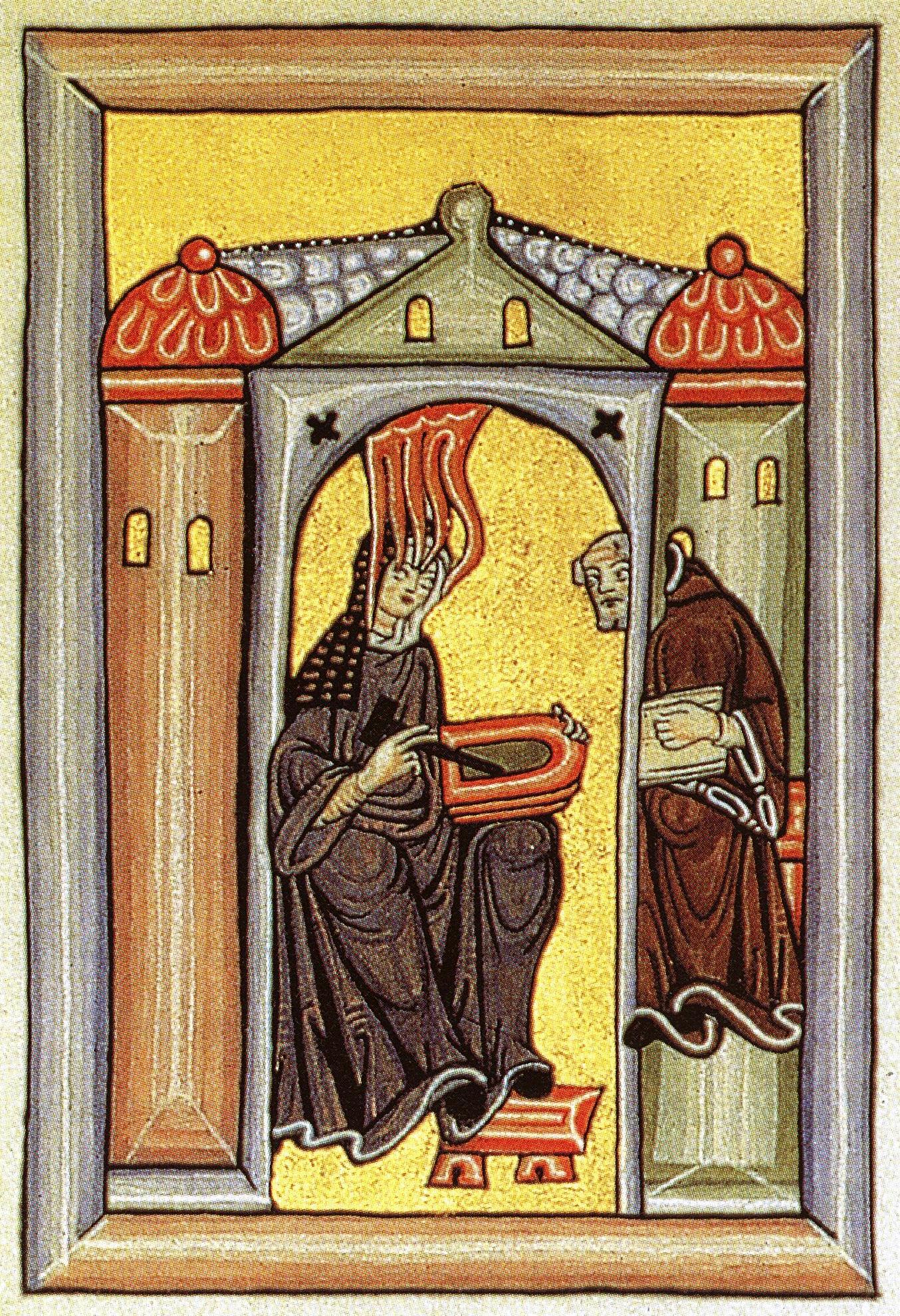
Hildegard of Bingen receiving divine inspiration and dictating her vision to the monk Volmar. Miniature from the Rupertsberg Codex of Scivias, c. 1175. Public domain.