How Much Older Than Homer Are Homer's Stories?
Artificial intelligence is helping scholars uncover patterns in the undeciphered script Linear A, but the larger mystery is whether the lost language of the Minoans preserves stories that predate Homer and reveal forgotten roots of Greek civilization.
Part I: The Civilization We Cannot Hear
More than a thousand years before the rise of Classical Greece, the Minoans built one of the Mediterranean's first great civilizations on the island of Crete. Their palaces at Knossos, Phaistos, Malia, and Zakros controlled trade networks that stretched across the eastern Mediterranean. Archaeologists have uncovered storerooms filled with giant storage jars, workshops, shrines, frescoes, and administrative archives that reveal a sophisticated Bronze Age society.
The Minoans also left behind a writing system known as Linear A. Hundreds of inscriptions survive on clay tablets, libation vessels, sealings, and other objects. Many were discovered in the palace complex at Knossos, where archaeologists later found tablets written in Linear B, the script that was eventually deciphered as an early form of Greek.
At first glance, Linear A appears to offer many of the clues needed for translation. Scholars know where many tablets were found. They can identify numerical symbols. They can often distinguish administrative records from religious texts. Some words appear repeatedly across multiple sites, suggesting the names of places, commodities, officials, or deities. Researchers can even assign approximate phonetic values to many signs because Linear B evolved from the same writing tradition.
Yet the language itself remains unknown.
The challenge becomes clearer when looking at actual inscriptions. One frequently cited sequence appears as:
A-SA-SA-RA
The term occurs on several Minoan religious objects and appears often enough that scholars suspect it may refer to a deity, a title, or a ritual concept. Researchers can identify the sequence, compare where it appears, and analyze the surrounding symbols. What they cannot do with confidence is translate it.
Administrative tablets present a similar puzzle. Many appear to follow predictable formats involving names, quantities, and commodities. Archaeologists can recognize numerical signs and infer that the texts probably record inventories, offerings, taxes, or distributions of goods. The overall structure is visible. The meaning of many individual words remains uncertain.
Imagine inheriting a spreadsheet written in an unfamiliar language. Repeated entries would reveal categories. Numbers would identify inventories and totals. Certain terms would appear only beside quantities, while others would appear in positions normally occupied by names or locations. Even without understanding the language, one could infer how the document worked. Determining what the labels actually meant would be far more difficult.
Linear A presents a similar challenge. Researchers often know how a word functions within a text without knowing what the word actually means.
The contrast with Linear B is striking. After architect Michael Ventris deciphered Linear B in 1952, thousands of Mycenaean records suddenly became readable. Tablets from Knossos could be understood as inventories of sheep, grain, olive oil, bronze, and other commodities. Many of the earlier Linear A tablets appear to record similar administrative activities, yet their contents remain inaccessible.
In effect, archaeologists possess part of the library of Minoan Crete. They can sort the books by subject, estimate which shelves contain accounting records and which contain religious texts, and identify recurring names and locations. What they still cannot do is read most of the sentences.
The famous Phaistos Disc, which I discussed previously in The Disc That Defies AI represents the most recognizable expression of this broader problem. Its 241 stamped symbols have attracted generations of researchers, but the disc is only one artifact. The larger mystery lies in the thousands of Linear A inscriptions scattered across Minoan Crete. Together they preserve fragments of an entire civilization's written record, a record that scholars can analyze, classify, and pronounce, yet still cannot fully understand.
That larger challenge has now attracted a new generation of investigators: artificial intelligence researchers.

The Berlin Painter, Achilles fighting Hector and Memnon, Attic red figure volute krater, c. 490 BCE, British Museum. Achilles appears here centuries after Homer and perhaps a millennium after the earliest traditions that may have inspired the hero. The gap between story, memory, and history remains one of the great mysteries of the ancient world.
Part II: Teaching Machines to Read a Lost Language
For most of the past century, efforts to decipher Linear A relied on traditional tools: archaeology, linguistics, and comparison with related scripts. Recent advances in artificial intelligence have added a new set of techniques to the search.
Researchers are not asking AI to perform a direct translation of Linear A. There is no answer key against which a translation can be checked. Instead, they are using machine learning to attack smaller pieces of the puzzle.
One approach involves pattern recognition. A neural network can scan thousands of inscriptions and identify which symbols tend to appear together, which words occur in similar contexts, and which sequences appear unique to religious or administrative texts. Such analysis can reveal structure even when meaning remains unknown.
Another approach examines geography. Linear A inscriptions have been found at Knossos, Phaistos, Malia, Zakros, and other Minoan sites. By comparing the distribution of words across locations, researchers can identify terms that may represent place names, commodities, official titles, or religious concepts. A word appearing only at one site might refer to a local institution, while a term appearing across the island could indicate a widely recognized office, product, or deity.
A third strategy uses comparison. Because Linear A shares visual similarities with Linear B, scholars can assign approximate phonetic values to many signs. Machine learning models can then compare the resulting word patterns against hundreds of known languages and language families. Researchers at the University of Melbourne are exploring whether deep learning systems can identify structural similarities that might point toward the linguistic relatives of the Minoan language.
The results have been promising, but modest. AI can identify recurring sequences. It can classify inscriptions. It can estimate which words are likely to be names, places, or commodities. It can even suggest possible grammatical structures. Yet none of these achievements amounts to a translation.
The challenge becomes clear when considering one of the best-known Linear A sequences:
A-SA-SA-RA
The term appears frequently enough that scholars suspect it may have religious significance. AI can determine where the sequence appears, what symbols surround it, and whether it behaves similarly to known divine names in other ancient languages. What AI cannot yet determine is whether the sequence refers to a goddess, a priesthood, a ritual, a sanctuary, or something else entirely.
Despite all these innovations, Linear A remains undeciphered.
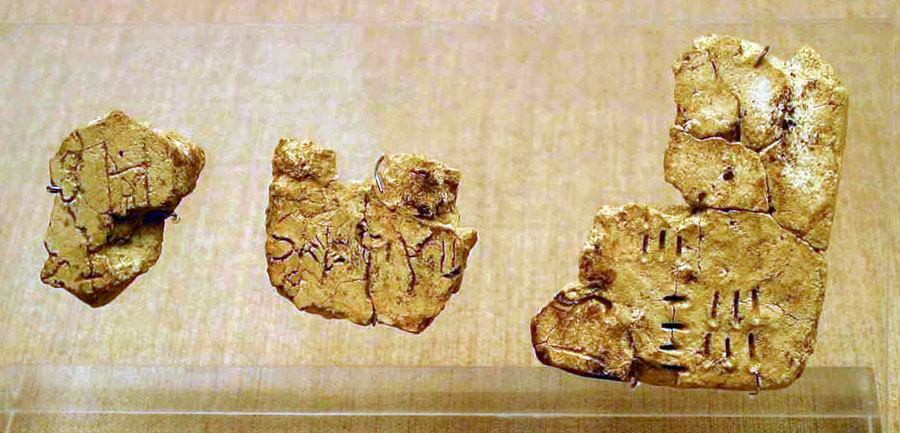
Linear A tablets from Akrotiri on Santorini, c. 1600 BCE. The symbols preserved on these clay tablets remain unread, leaving open the possibility that important aspects of Minoan history, religion, and literature have yet to be recovered. Prehistoric Museum of Thira. Wikimedia Commons image by Portum and Securiger, CC BY-SA 3.0.
The reason lies in a combination of unfortunate circumstances. Only about 1,400 inscriptions have been found, many containing just a handful of words. Most surviving texts appear to be administrative records rather than narratives, legal codes, or literature. The underlying language remains unknown. Most importantly, no bilingual inscription equivalent to the Rosetta Stone has ever been discovered.
Artificial intelligence can compensate for some of these limitations. It can identify patterns, classify symbols, compare structures, and test linguistic hypotheses more quickly than human researchers. What it cannot do is create evidence that no longer exists.
Researchers already know a surprising amount about the script. They can identify recurring words, distinguish religious texts from administrative records, recognize numerical systems, and infer how inscriptions were organized. In some cases they can even pronounce the symbols.
The remaining gap is meaning.
That gap may prove to be the hardest problem in archaeology and one of the most revealing tests of artificial intelligence.
The possibility becomes even more intriguing when viewed through the lens of Homer. Scholars have long recognized that the Iliad and Odyssey preserve memories of a world much older than the poet traditionally credited with composing them. Homer likely lived in the eighth century BCE, yet the societies described in his epics belong to the Late Bronze Age, centuries earlier. Several names associated with Homeric heroes may already appear in Linear B tablets, suggesting that parts of the tradition were circulating long before the poems were written down.
That observation raises a deeper question: how much older than Homer are Homer's stories?
Most scholars agree that the Trojan War traditions predate Homer by centuries. The more difficult question is whether some elements of Greek mythology reach back even further. No scholar has identified Achilles, Troy, or the Trojan War in Linear A texts. Yet the Minoan civilization flourished centuries before the Mycenaean world that produced the Linear B archives. If later Greek myths preserved memories of Bronze Age Greece, might some of those memories contain traces of an even older Minoan past?
A deciphered Linear A archive may not reveal Homer. It could reveal something even more surprising: stories, myths, and religious traditions that Homer's world inherited, transformed, and only partially remembered.
A final possibility deserves consideration. Discussions of Linear A often assume that all of the important texts have already been found and that the remaining challenge is decipherment. Archaeology suggests otherwise.
Linear A inscriptions have been discovered not only on Crete but across parts of the Aegean, including Santorini and several Cycladic islands. Most surviving texts appear to be administrative records preserved largely by accident. Fires baked clay tablets. Buildings collapsed. Settlements were abandoned. The documents that survived may represent only a tiny fraction of what once existed.
Historians naturally compare ancient literary traditions to works such as the Epic of Gilgamesh, the Iliad, and the Odyssey. The Minoans dominated parts of the Aegean for centuries. They built monumental palaces, maintained far-reaching trade networks, and developed a sophisticated religious culture. It would be surprising if they possessed no myths, heroic narratives, religious stories, or historical traditions of their own.
Yet no such texts have been securely identified.
The reason may be simple. Literary works were often written on perishable materials that rarely survive Mediterranean climates. Clay tablets used for accounting were preserved by accident. Poems, stories, and chronicles may have vanished long ago.
We often ask whether Linear A contains a Minoan version of the Iliad. The more immediate question is whether we would even recognize it if we found it. Until the language is deciphered, a heroic narrative and a grain inventory can appear remarkably similar. Both are sequences of symbols written in a script we do not understand.
That possibility changes how we think about the problem. The mystery of Linear A is not merely a question of translation. We may still be searching for the texts themselves.
Somewhere beneath volcanic ash on Santorini, within an unexcavated storeroom on Crete, or on another Aegean island yet to reveal its secrets, there may exist documents that would transform our understanding of the Bronze Age. Four thousand years after the Minoans recorded their words, the next great discovery may not be a better algorithm.
It may be the recovery of a lost voice.
And if that voice survives, it may tell stories that were already ancient when Homer was born.
Further Reading
- Computational Approaches to Deciphering Linear A and Related Scripts
- Using Deep Neural Network Models in the Decipherment of Linear A
- The Disc That Defies AI