Maybe There Is Something Inside the Great Pyramid?
A new computational study proposes that the Great Pyramid's ramps were built into the pyramid and then backfilled, and that one of the unexplained spaces inside the monument sits remarkably close to where the model puts a haul lane.
Maybe There Is Something Inside the Great Pyramid?
The Great Pyramid of Giza can be measured to the centimeter and walked through along several of its passages, but the construction site that produced it has left almost nothing behind. Roughly 2.3 million blocks were raised to a height of about 146.6 m over a base of about 230 m per side, and the strongest evidence about how that was done consists of what is absent: no foundations for a monumental external ramp at Giza, no attested footings, no unambiguous trace of the infrastructure that any plausible lifting system would have required.
A study published in npj Heritage Science in March 2026 treats the gap as an engineering and logistics problem. Vicente Luis Rosell Roig, an independent researcher based in Valencia, makes no claim to have identified the method Khufu's builders used. The paper instead runs one construction hypothesis end to end through a single pipeline of parametric geometry, discrete-event simulation, and staged structural analysis, and reports where that hypothesis would have left marks. It matters less for the ramp it proposes than for the connection it draws between two questions usually kept apart: how the pyramid was built, and why instruments keep finding spaces inside it that appear on no plan.

The Pyramids of Giza, viewed from the Grand Egyptian Museum, 2024. Photograph by Caoimheen3, via Wikimedia Commons. Licensed under CC BY-SA 4.0.

The Ramp That Was Never Removed
Every construction theory eventually meets the same obstacle. Blocks had to move upward, which implies ramps, and a ramp serving a 146 m monument would itself have been an enormous earthwork to raise and then remove. The Integrated Edge Ramp, or IER, proposes that the transport system was never external at all. A mask of perimeter blocks is temporarily omitted along the active edge of each course, opening an air channel roughly 3.8 m wide that climbs helically with the structure at a grade near 7°, turning 90° at corners where enlarged platforms let teams pivot the sledges. Once the pyramidion is set, crews descend, backfill the omitted positions, and clad the faces.
The arrangement dissolves the missing-ramp problem rather than answering it, since on this account there was never an external ramp to leave foundations behind. The pyramid was the ramp. A second advantage matters more to the argument. An open-air notch, unlike an enclosed tunnel, leaves the arrises visible for the sighting lines Old Kingdom survey depended on and leaves the inactive faces clear for progressive casing, whereas external and zig-zag ramps bury the faces they climb. Jean-Pierre Houdin's internal spiral gains the same casing advantage but requires a roofed corridor no survey has found.
One Ramp Is Not Enough
The more useful move is that the paper tests whether the geometry survives arithmetic, and on the first pass it does not. A single helical channel dispatching a block every 4 minutes yields 49.51 working years, roughly double Khufu's reign. Rather than adjusting the headway until the number cooperates, the model changes the topology: identical channels run on several faces at once, and the count falls as the courses narrow, from 16 across the enormous lower courses to 8, then 4 through the long middle ascent, then 2, then 1 near the summit.
Parallelization cuts the modeled construction time from 49.51 years to about 13.7, and under deliberately unfavorable assumptions to 20.6. Adding planning, quarrying, river transport, and seasonal pauses keeps the whole project between roughly 20 and 27 years, which is where the Wadi al-Jarf papyri put Khufu's reign. The channels themselves cost little, since the temporarily omitted blocks come to under 2% of the total.
What emerges is an argument about coordination rather than muscle. The binding constraint is not how many people can pull a rope but how often a block can enter a lane without the lane seizing up, which turns a famous question about labor into one about scheduling. Old Kingdom construction, on this reading, looks less like a feat of massed strength than like a logistics network with buffers, headways, and traffic control.
A Corridor Where the Model Puts a Haul Lane
Modern instruments keep finding spaces the plan does not account for. Cosmic-ray muons pass through hundreds of meters of stone, and variations in how many reach a detector reveal regions of lower density, which is how the ScanPyramids collaboration announced the Big Void in 2017, a feature extending at least 30 m above the Grand Gallery. The North Face Corridor, found later, has since been measured at roughly 2.3 by 2.15 by 9.1 m, lying 11 to 20 m behind the reconstructed casing plane. Neither appears on the conventional plan, and neither has an agreed purpose.
Against that background the paper reports a coincidence it takes care not to oversell. The four-ramp simulation puts the upper perimeter haul lane across the north face at about 39.4 m elevation with a setback near 13.4 m, inside the corridor's depth range. Two further alignments point the same way: the best fit to the published anomaly centroids falls at 7.4° to 7.5° across the tested grades, and a pre-specified comparison against McKenzie's course-thickness series finds a 7.4° helix placing its turning tiers where 5 of 10 post-turn thickness jumps occur. Rosell Roig calls all of it geometric correspondence and asserts no functional relationship, which is the right call given that muography cannot yet tell a backfilled channel from other heterogeneity by proximity alone. In panel b of the figure below, the green volume is the corridor as constrained by muography and resistivity data, and the brown track is the haulage lane the model predicts.
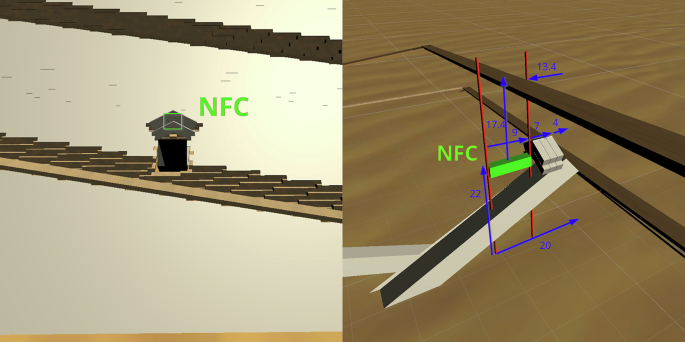
Two readings remain open beyond what the paper argues, and the distinction belongs to the interpretation rather than to the source. The corridor may be construction access that was sealed and forgotten, perhaps linked by a short temporary stair to the main entrance about 17 m up the same face. It may also be a corridor in the ordinary sense, with a gabled vault whose chevrons plausibly served a relieving function, in which case the two explanations are not competitors: a passage created because the build required it could have been kept because the architecture wanted it. The modern separation between construction scar and designed space may be a category the builders had no reason to observe. What makes the correspondence worth taking seriously, though, is the space the same model refuses to claim.
The Space the Model Cannot Explain
The IER offers a possible explanation for the North Face Corridor, and it explicitly does not account for the Big Void. Rosell Roig states plainly that the model predicts nothing at that location, and a feature extending at least 30 m above the Grand Gallery is far too large to write off as an irregularity in the masonry. A theory flexible enough to absorb every anomaly after the fact would be nearly impossible to falsify, so declining to absorb the largest one is what keeps the rest testable. The biggest unexplained space in the pyramid stays unexplained, and detecting empty space says nothing about why the space is there.
What the model can do in exchange is fail. Because it specifies where the channels ran and where they were closed, it predicts what closure should look like: edge bands of lower density carrying rubble-and-mortar signatures rather than the uniform void of a preserved tunnel, wear at the corners where sledges were pivoted, and no external ramp bases anywhere on the plateau. Radar, resistivity tomography, higher-resolution muography, endoscopy, and petrographic examination can all look for those signatures at elevations the paper supplies, including a falsifiable extension to Khafre's pyramid. The limitations are stated in the same register: an idealized monolithic limestone body, friction values from sledge experiments rather than from Giza, and muographic coverage weakest precisely near the edges, so non-detection there settles little.
No Egyptological response has yet appeared. The paper has been widely covered, occasionally under headlines announcing that the pyramid has been solved, but the specialist literature contains no reply five months after publication, and the author's open invitation to test the archived code has so far gone unanswered. The nearest precedent is instructive. Jean-Pierre Houdin's internal ramp drew objections from David Jeffreys of University College London, who called it "far-fetched and horribly complicated", and from John Baines at Oxford, who distrusted any theory that explains only the Great Pyramid, while Zahi Hawass observed that the pyramids built immediately after Khufu's show no sign of an internal ramp. The Khafre prediction is the IER's answer to the last of those, and it remains untested.
The methodological shift matters more than the ramp. Construction theories have been hard to adjudicate because the finished monument conceals the evidence needed to reconstruct the process, which left the field arguing about plausibility, whereas a computational framework starts from a proposed method, derives where that method must have altered the structure, and sends instruments to those coordinates. Rosell Roig's data and code are archived openly on Zenodo, so rival hypotheses can be run through the same pipeline and compared on distances, work, and cadence rather than on rhetorical fit.
The contrast with how the pyramid's known interior was found is worth holding onto. When Howard Vyse opened the upper relieving chambers above the King's Chamber in 1837, the method was gunpowder, blasted upward from Davison's Chamber over several months. The Big Void and the North Face Corridor were found by counting cosmic-ray muons from outside the monument and characterized by radar, ultrasonic testing, and resistivity tomography without a stone being moved; the single intrusion was a millimeter-scale endoscope passed through an existing opening in the joints behind the lower chevron blocks in 2023. A remarkable discovery has therefore already happened, and what has not happened is the interpretation, because detection reports where density falls rather than why. A backfilled haul channel, a relieving void, a sealed passage, and an intended chamber all register at present resolution as less stone in one place, and a predictive model is what sorts that undifferentiated signal into categories from outside.
Something is inside the Great Pyramid, and the instruments will only get better at finding more of it. The more valuable question is no longer whether unexplained spaces exist but whether they can be sorted by origin: some the residue of getting stone to the top, some structural, some passages, some rooms the builders meant to be there. Doing that sorting without opening anything would be a remarkable achievement, engineering and mathematical modeling explaining from outside the marks a construction method left inside. The same exercise would also isolate what it cannot explain. A model that accounts for the spaces around the Big Void and nothing about the void itself makes the strongest case yet that the Big Void is the one worth opening.
Further Reading
- Vicente Luis Rosell Roig, "A computational framework for evaluating an edge-integrated, multi-ramp construction model of the Great Pyramid of Giza", npj Heritage Science 14, 142 (2026) — the study discussed here, open access.
- Zenodo deposit 10.5281/zenodo.16732345 — the model's code, geometries, meshes, and Monte Carlo outputs, archived under an open licence.
- Procureur, Morishima et al., "Precise characterization of a corridor-shaped structure in Khufu's Pyramid by observation of cosmic-ray muons", Nature Communications 14, 1144 (2023) — the muon imaging behind the North Face Corridor.
- Pugacheva et al., "Investigation of the North Face Corridor in the Great Pyramid of Giza using electrical resistivity tomography", Scientific Reports 15, 41187 (2025) — the survey that fixed the corridor's dimensions and depth envelope.
- Scheuring, "Construction of the Great Pyramid with pulley-like systems using counter-weights on sliding-ramps", npj Heritage Science 13, 473 (2025) — a competing mechanism, argued against directly in the paper above.
- Ivashov et al., "Discussion of the non-destructive testing possibilities for the study of the Great Pyramid of Giza", Heritage 6, 5867 (2023) — on what these instruments can and cannot currently resolve.