Music at the Edge of the Atomic Age
Two Films Imagine Music at the Trinity Test. What Does It Mean?
Cinema’s Trinity ▪
Before dawn on July 16, 1945, scientists gathered in the New Mexico desert for the Trinity test, the first detonation of a nuclear weapon. Communication between the control bunker and observation posts several miles away depended on radio links that engineers worried might fail once the device detonated. The explosion itself could disrupt radio frequencies, so backup timing systems and visual signals were prepared in case transmissions were lost. Contemporary accounts describe a technical atmosphere of countdown checks, weather updates, and tense listening. No music played over the loudspeakers.
Films later imagined a different moment. In Fat Man and Little Boy (1989), radio interference distorts communication during the countdown. Into that sudden static comes orchestral music from The Nutcracker Suite by Tchaikovsky. Elegant nineteenth century music appears to accompany the birth of the atomic age. Oppenheimer is portrayed staring at the speaker, visibly unsettled, before recommitting to the countdown. Some historical accounts suggest that the idea of music at Trinity may not be entirely fictional. The Manhattan Project used short-wave radio to transmit the countdown from the S-10,000 control bunker to observation posts around the test site. Because of overlapping frequencies, the signal reportedly picked up interference from a powerful Voice of America broadcast originating on the West Coast. As physicist Samuel Allison conducted the countdown, witnesses later recalled hearing fragments of classical music and even the national anthem mixed with the transmission over loudspeakers. Popular retellings often identify the music as Tchaikovsky’s Nutcracker Suite, though some sources suggest it may actually have been his Serenade for Strings. Whatever the exact composition, the accidental pairing of Tchaikovsky and the atomic countdown became one of the more surreal anecdotes associated with the Trinity test.
In Oppenheimer (2023), director Christopher Nolan approaches the Trinity scene differently. Instead of using Tchaikovsky’s music, Nolan relies on an original score by Ludwig Göransson and long stretches of near silence. The effect is highly controlled. Nolan delays the sound of the explosion, forcing the audience to experience the detonation visually before the shockwave arrives.
Technical Mastery ▪
Both achievements represent extreme technical skill. A ballet score such as the Nutcracker requires careful orchestration, precise rhythm, and a deep understanding of harmonic structure developed across centuries of musical practice.
The Trinity device required the same discipline in a different domain. Engineers built explosive lenses that had to detonate within microseconds of one another. Physicists modeled neutron behavior inside a collapsing plutonium core. Electronics teams designed timing systems capable of coordinating the entire mechanism.
Both depended on mathematics, precision, collaboration, and long training. One produced music heard in concert halls. The other produced a flash brighter than the sun and began the nuclear age. The same technical mastery made both possible, and helped shape history.
Further Reading
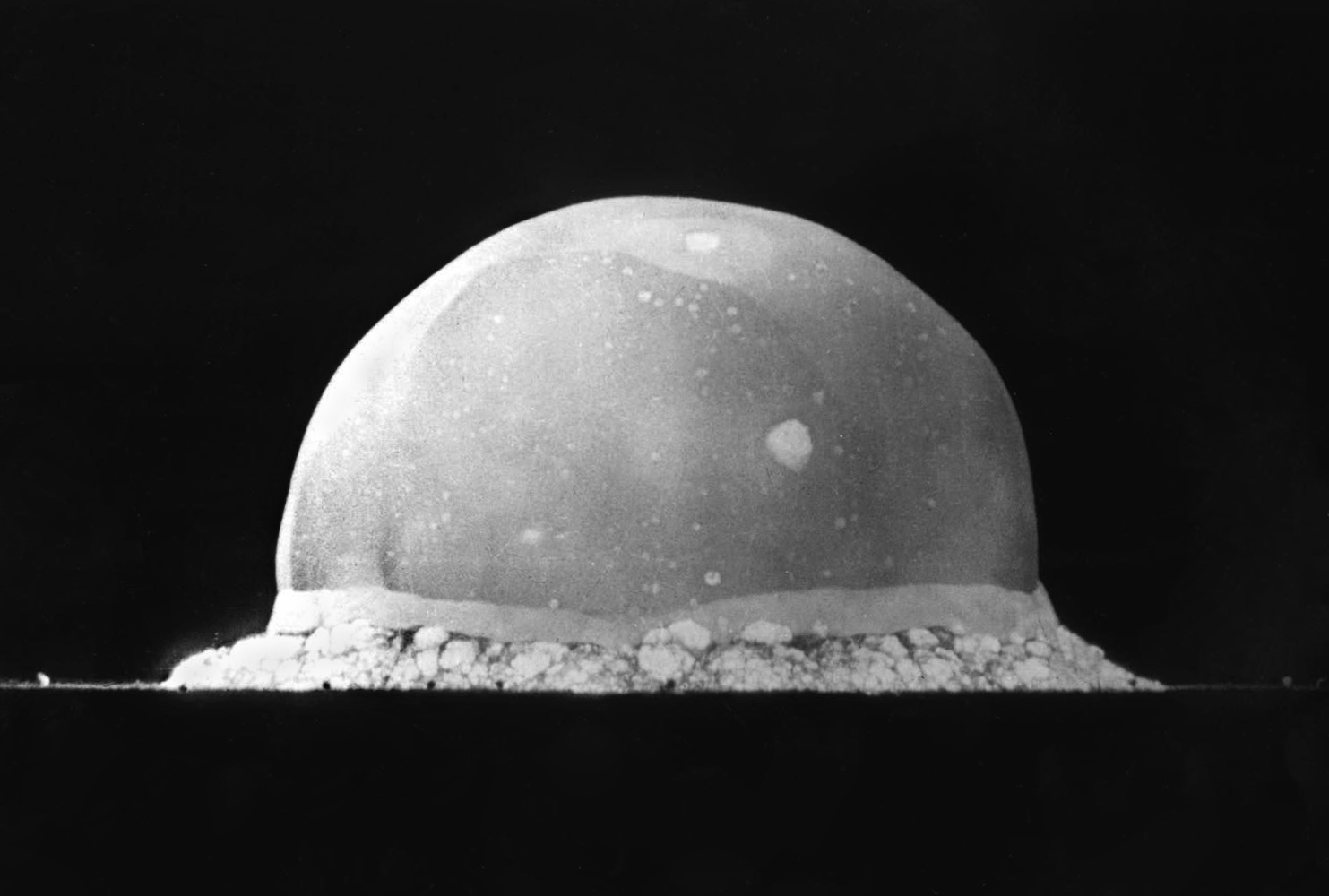 Trinity test fireball, 0.016 seconds after detonation, New Mexico, July 16, 1945. Photo: Berlyn Brixner, Los Alamos National Laboratory. Public domain.