One Year Later: What Comes Next?
Nearly 400 blog entries later, a simple commitment to write for one year evolved into an exploration of how human beings create, preserve, interpret, and transmit knowledge during periods of technological change.
Part I: The Unexpected Conversation
A year of writing reveals patterns that only become visible when individual essays are viewed as part of a larger archive.
When I launched this blog a year ago, the objective was remarkably simple. I wanted to publish regularly for twelve months and determine whether a public commitment could succeed where private intentions often failed. The project was conceived as an exercise in discipline rather than an attempt to build a publication. If the experiment accomplished nothing more than establishing a sustainable writing habit, it would have been worthwhile.
Artificial intelligence quickly became part of that effort, though not in the way many discussions about AI and writing suggest. The technology did not generate the curiosity that drove the project, nor did it determine which questions deserved attention. Those questions emerged from books, conversations, professional experiences, travel, research papers, and longstanding interests in history, science, education, and technology. AI instead changed the economics of writing by reducing the friction between an idea and a finished essay. Research became easier to organize, sources became faster to locate, and editing became more efficient. The result was not less thinking but more opportunities to pursue ideas that might otherwise have remained unexplored.
That reduction in friction produced an unexpected outcome. Rather than writing occasionally, I found myself writing almost daily. Individual posts often began with unrelated observations, yet the archive gradually revealed patterns that were not visible at the outset. Artificial intelligence appeared frequently, but so did ancient history, archaeology, higher education, scientific discovery, governance, film, religion, economics, and classical learning. Looking back across the year's titles, from The Book of Kells and Machine Learning to Before Greek Fire, from St. John's College Preserved How to Think in the AI Era to Does AI Belong to the Chain of Life or Is It an Artifact?, the subjects appear diverse enough to resist categorization.
What became apparent only in retrospect is that many of these essays were exploring variations of the same question. Whether the topic involved medieval manuscripts, machine learning models, Roman cities, universities, data governance, scientific institutions, or questions of identity, the underlying concern remained surprisingly consistent: how do human beings create, preserve, interpret, and transmit knowledge during periods of rapid technological change?
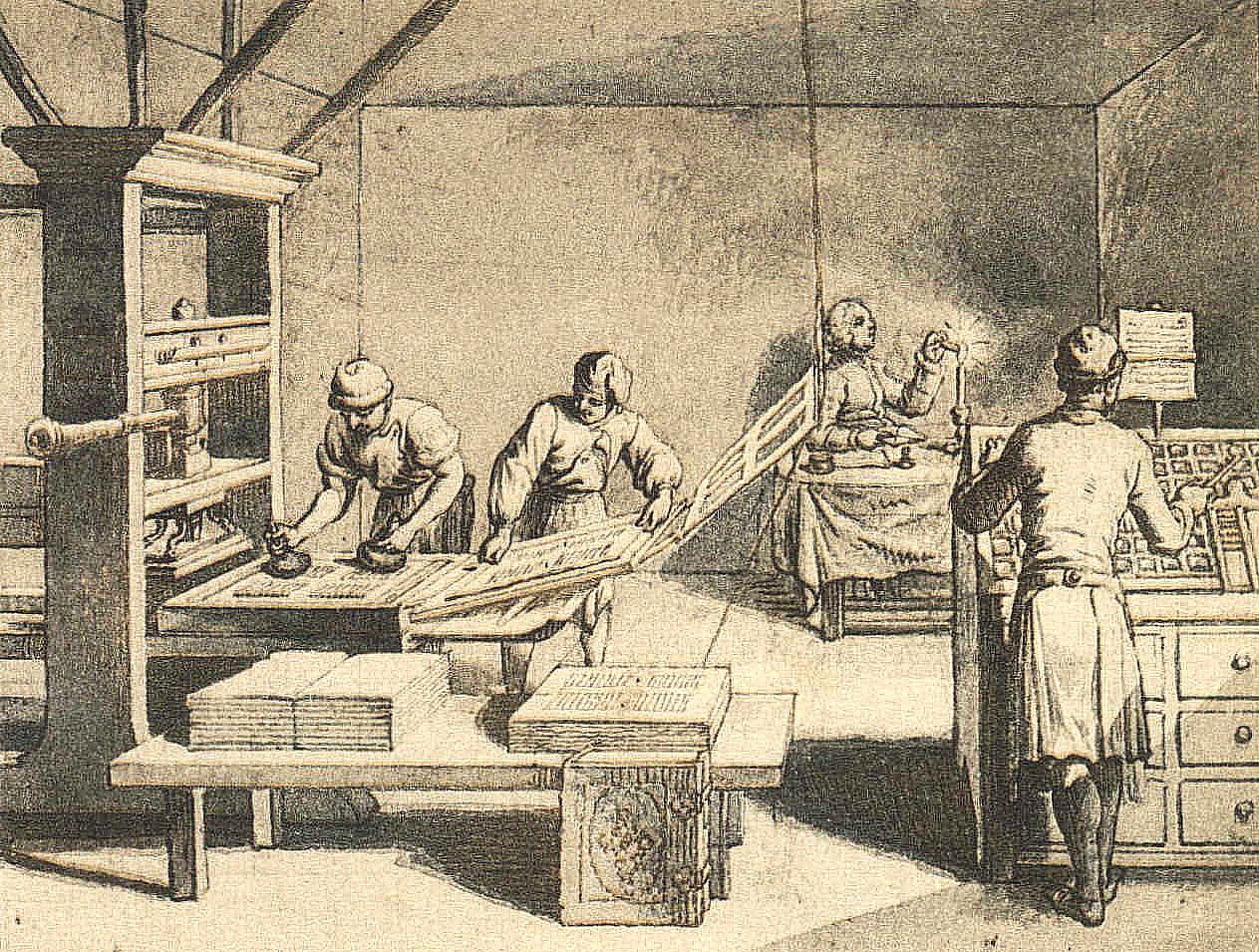 Daniel Nikolaus Chodowiecki, Die Buchdruckerei (The Printing House), c. 1770. An eighteenth-century printing workshop, representing an earlier technological revolution in the creation, preservation, and dissemination of knowledge. Public domain.
Looking across the archive, the recurring subjects are surprisingly consistent. Artificial intelligence appears frequently, yet so do monasteries, libraries, universities, archives, scientific institutions, and ancient civilizations. Each represents a different solution to the same challenge: preserving knowledge across generations while adapting to changing technologies. The monks who copied manuscripts, the librarians who organized collections, the universities that transmitted learning, and the engineers building artificial intelligence systems all confront the same challenge: preserving knowledge while adapting to technological change. What initially appeared to be a collection of unrelated essays now looks more like a sustained inquiry into the relationship between innovation and memory.
The archive was not the only source of insight. Reader behavior revealed a similar pattern. The most widely read essays were rarely the most technical. Readers consistently gravitated toward questions of judgment, trust, identity, expertise, and the relationship between technology and society. Pieces such as AI Agents Rising, AI Passed the Turing Test but Failed the Watch Test, Why Is the Ancient Aliens Idea Both Wrong and Wonderful?, and AI Is Not Your Lawyer attracted far more attention than highly specialized discussions of data or technology. The pattern suggests that readers are less interested in artificial intelligence as a technical achievement than in its implications for how human beings think, decide, and understand the world. In an unexpected way, the audience reinforced the same conclusion that emerged from the archive itself: the most interesting questions often arise where technology intersects with human experience.
The readership data provided an independent test of the archive's themes.
Most Read Blog Entries from Year One
| Essay | Why Readers Responded |
|---|---|
| AI Agents Rising | Explored the arrival of autonomous AI systems that move beyond traditional chatbots. |
| Why This Site? | Explained the purpose of the project and the questions it hoped to explore. |
| AI Passed the Turing Test but Failed the Watch Test | Examined the difference between language fluency and genuine understanding. |
| Why Is the Ancient Aliens Idea Both Wrong and Wonderful? | Connected archaeology, curiosity, and the human search for explanations. |
| AI Is Not Your Lawyer | Explored how long-standing institutions are adapting to artificial intelligence. |
That realization may be the most important outcome of the first year. Individual posts matter less than the relationships that develop between them. A single essay captures a momentary idea. An archive begins to reveal recurring concerns, intellectual habits, and assumptions about the world. The most surprising result of the experiment was not the number of essays produced but the discovery that a coherent set of themes emerged without being deliberately planned.
Looking back, I realize that many of the subjects that interested me professionally, higher education, data governance, and artificial intelligence, were leading toward the same questions that first attracted me to history, archaeology, and the liberal arts. The blog began as an experiment in writing. It became an investigation into how knowledge survives technological change.
Part II: From Blog to Publication?
That realization raises a question that did not exist a year ago. If the first challenge involved establishing a writing habit, the second may involve determining what the habit has produced.
Bear Blog proved exceptionally well suited to the first stage of the journey because its design philosophy aligns with the needs of a writer trying to build consistency. The platform removes much of the complexity that accompanies modern publishing and keeps attention focused on the act of writing itself. Looking back, it is difficult to imagine a better environment for experimentation because the site continually rewards publication rather than optimization. Its greatest contribution may have been its refusal to become part of the story.
Yet the success of that simplicity creates a new set of considerations. During the first months, the blog functioned primarily as a notebook, a place to test ideas and develop the discipline of writing publicly. As the archive expanded, however, the character of the project began to change. Essays started referring to earlier essays. Themes reappeared and evolved over time. Readers returned not simply for individual posts but for the larger conversation unfolding across them. What began as a collection of entries increasingly resembles an ongoing intellectual project.
That evolution helps explain why platforms such as Ghost have become more interesting. The attraction is not technological novelty, nor is it a desire for more features. Bear Blog already accomplishes its primary purpose extremely well. The distinction is deeper. Bear Blog is optimized for exploration. Ghost is optimized for continuity, curation, and the long-term development of an intellectual project.
One platform asks whether there is something worth writing today. The other asks whether the accumulated work has become substantial enough to sustain a publication.
That difference matters because the questions facing the project have changed. The issue is no longer whether there are enough ideas to sustain a blog. The archive has already answered that question. The issue is whether a growing body of work devoted to technology, history, institutions, and knowledge would benefit from a structure designed to support a continuing publication rather than a personal notebook.
I do not yet know the answer. What I do know is that the first year produced something I did not anticipate. A project that began as an experiment in consistency became an exploration of how technology, history, institutions, and culture intersect in the creation and preservation of knowledge. Whether that conversation continues on Bear Blog, migrates to Ghost, or evolves in some entirely different direction remains an open question. The more interesting fact is that the question now exists at all.
A year ago, the challenge was simply to begin. The first year demonstrated that curiosity, aided by new tools and sustained by regular practice, could produce far more than a collection of essays. It produced an archive, a set of recurring themes, and an ongoing conversation about technology, history, institutions, and knowledge.
The second year begins with a different question. The archive has already demonstrated that there will always be another subject, another historical parallel, or another technological development worth exploring. A more interesting challenge now emerges: determining what this conversation is becoming, and what kind of home it deserves.
Appendix: The Next Platform?
Bear Blog vs. Ghost
| Consideration | Bear Blog | Ghost |
|---|---|---|
| Primary Identity | Blog | Publication |
| Core Philosophy | Simplicity and writing first | Publishing and audience development |
| Writing Experience | Excellent | Very good |
| Long Form Essays | Good | Excellent |
| Essay Series | Limited | Strong |
| Newsletter Capability | Minimal | Native feature |
| Subscriber Management | Minimal | Built in |
| Analytics | Basic | Advanced |
| Design Flexibility | Limited | Extensive |
| Maintenance Burden | Very low | Moderate |
| Best Use Case | Building a writing habit | Building a publication |
| Greatest Strength | Removes friction | Creates continuity and structure |
| Central Question | What should I write next? | What am I building? |