The Fly Inside the Machine: When Learning Stops and Being Begins
Artificial intelligence has long advanced by learning from data, yet a new line of research suggests a different path, one in which machines do not learn behavior, but reconstruct the architecture that gives rise to it.
From rules, to learning, to reconstruction
For most of computing history, machines followed rules. A calculator applies fixed logic and produces reliable outputs. There is no learning, only execution.
Modern artificial intelligence introduced a different method. Systems learn from large datasets, identifying patterns and generating outputs that resemble human language or decision-making. These models do not rebuild the processes they imitate. They approximate them through probability.
A new line of research takes a more direct path. Instead of training a system to behave like an organism, researchers attempt to reconstruct the organism’s underlying structure. By simulating every neuron and connection in a fruit fly brain and placing it in a virtual environment, behavior emerges from the system itself rather than from learned approximation.
The distinction is not merely technical. One approach studies outcomes. The other rebuilds the mechanism that produces them.
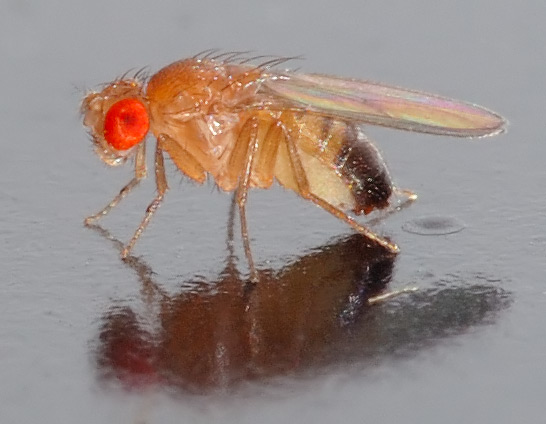 Male Drosophila melanogaster (fruit fly), approximately 2.5 × 0.8 mm, a widely used model organism in neuroscience and genetics. Image by André Karwath, CC BY-SA 2.5.
Why a simulated fly matters
A fruit fly is small enough to simulate but complex enough to exhibit real behavior. It moves, reacts, explores, and adapts to its environment. These are not trivial actions. They arise from a functioning biological system.
When a simulated fly begins to act in ways consistent with its biological counterpart, the system is not predicting what a fly might do. It is producing what a fly does. No training dataset is required to teach it how to walk or respond. The capacity to act is already embedded in its architecture.
That difference has practical consequences. Traditional AI systems can generate convincing outputs, yet they remain dependent on the data used to train them. A reconstructed system operates from internal organization. Errors, when they occur, resemble biological limitations rather than statistical misfires.
Such systems also require context. A simulated brain must exist within an environment, receiving input and producing output. Intelligence becomes less about isolated computation and more about interaction with a world, even if that world is virtual.
A different future for Artificial Intelligence
If this approach scales, artificial intelligence may follow two distinct paths. One will continue to refine statistical models that learn from vast amounts of data. These systems will remain efficient, flexible, and widely deployable across domains such as language, analytics, and automation.
The second path will focus on reconstruction. By simulating increasingly complex nervous systems, researchers may produce forms of intelligence grounded in structure rather than training. Progress will be slower and more resource-intensive, yet the results may be more stable, interpretable, and aligned with biological cognition.
The broader implication reaches beyond engineering. For decades, the field has asked how machines might simulate intelligence. Reconstruction reframes the question. Intelligence may not be something that can be fully abstracted into data and algorithms. It may instead arise from the organization of a system interacting with its environment.
The future of artificial intelligence may depend less on teaching machines to imitate and more on understanding how to rebuild the conditions under which intelligence emerges.
Further Reading