The Romantic Return of the Liberal Arts in the AI Economy
Artificial intelligence is forcing universities, students, and employers to reconsider whether higher education exists primarily for workforce specialization or for the broader cultivation of human judgment, adaptability, and intellectual formation.
The Return of Craft in the AI Economy
Pulitzer Prize winning journalist Jodi Kantor recently posed a question haunting the Class of 2026: how does a young person begin a meaningful career in an economy increasingly shaped by artificial intelligence, automation, and instability? Her recent essay, adapted from her forthcoming book How to Start: Discovering Your Life’s Work, arrives at a moment when many graduates hear the same unsettling message from employers, economists, and social media alike: entry level work is changing rapidly, professional stability feels less certain, and AI may alter the relationship between education and employment in ways few fully understand.
Kantor’s response rejects both technological fatalism and career panic. Instead, she argues that durable careers emerge from the intersection of two forces: craft and need. Craft means developing mastery in something difficult and meaningful. Need means understanding what society genuinely requires over long stretches of time. The framework sounds almost old fashioned, yet it cuts directly against assumptions that shaped much of higher education during the last several decades.
For years, universities increasingly encouraged students toward specialization. Economic security appeared tied to optimizing for whichever field looked technologically ascendant at the moment. Earlier generations were told to learn Japanese during the economic anxieties of the 1980s. Later cycles emphasized finance, coding, biotechnology, data science, or machine learning. Each wave carried the same promise: technical specialization would provide stability in a rapidly changing economy.
Artificial intelligence may complicate that assumption.
Generative AI systems already perform portions of legal research, coding, administrative work, analytical synthesis, and customer interaction once assigned to junior professionals. The apprenticeship layer of many white collar industries is beginning to shift. Young workers increasingly encounter automated interviews, algorithmic hiring systems, and uncertain entry points into professional life. The anxiety surrounding recent graduates reflects a genuine structural transition rather than temporary pessimism.
Yet Kantor’s argument becomes more compelling precisely because of that disruption.
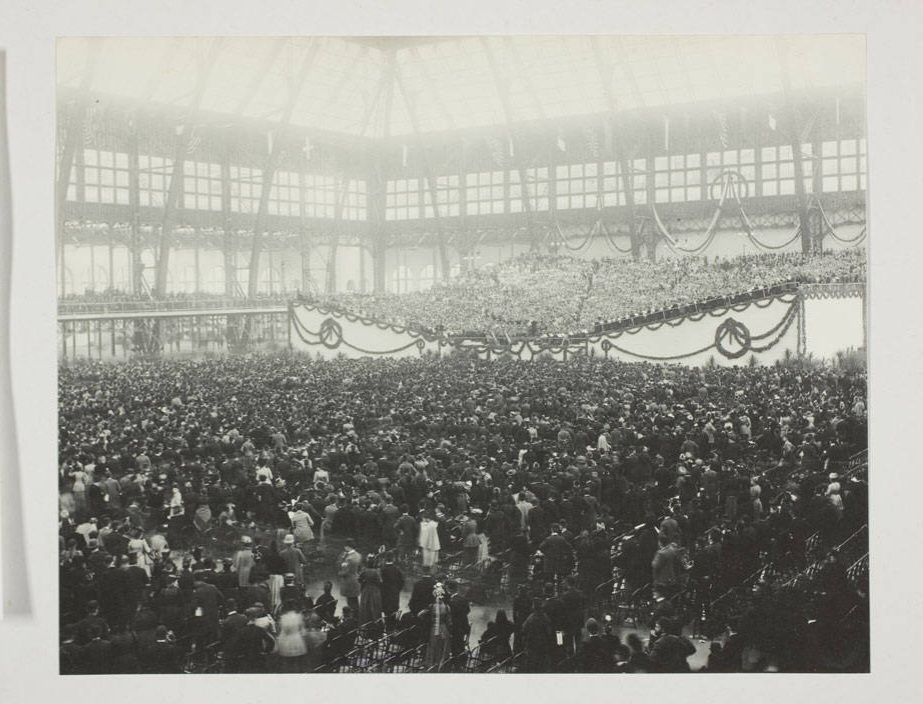
C.D. Arnold, Interior of the Manufacturers and Liberal Arts Building at the World’s Columbian Exposition, Chicago, 1893. Public domain. Courtesy of the Art Institute of Chicago / Wikimedia Commons.
The Romantic Return of the Liberal Arts
The temptation, particularly inside higher education, is to interpret this moment as a triumphant return of the liberal arts. Seminar discussion, interdisciplinary inquiry, close reading, persuasive writing, and philosophical reflection suddenly appear newly relevant in an economy where AI can automate portions of technical execution. A useful distinction is emerging between information and judgment. AI systems retrieve information rapidly. Judgment still requires interpretation, ethics, context, historical awareness, and the ability to navigate ambiguity.
That argument contains real insight. It also risks becoming romantic.
A recent conversation between Ross Douthat and philosopher Jennifer Frey sharpened this tension considerably. Frey warned against defending the humanities merely as a new source of “AI proof” workplace skills. Reducing humane learning to workforce utility, even in defense of the liberal arts, risks instrumentalizing the very thing universities claim to protect.
Her critique matters because many liberal arts institutions already spent years defending themselves against accusations of impracticality. Tuition costs rose even as graduates entered increasingly uncertain professional environments. Calls for broader intellectual formation often sounded less convincing to students facing debt, housing costs, and changing labor markets. Technical specialization remained attractive not because students rejected the humanities, but because specialization appeared economically safer.
AI does not erase those realities.
Medicine, engineering, scientific research, and software development still require deep expertise. Most graduates cannot rely on intellectual breadth alone. Economic life still rewards technical competence, credentials, and specialization in many fields. In practice, many students need both immediate employability and long term adaptability.
That tension makes Kantor’s concept of craft especially important. Her argument is not that everyone should become a philosopher. Nor is it a nostalgic defense of the university seminar room. Craft implies disciplined mastery developed slowly over time. AI may increase the value of people who combine technical competence with communication, ethical reasoning, synthesis, and institutional understanding. Breadth without competence becomes abstraction. Technical skill without adaptability risks fragility.
Frey’s own educational experiment at the University of Tulsa reinforces the point. Her Great Books honors program attracted large numbers of STEM students who pursued rigorous technical majors alongside seminar based liberal learning. The model did not reject specialization. It attempted to place specialization within a broader framework of intellectual and human formation.
The deeper issue may be instability itself. Specialization functions best in systems where professional pathways remain relatively fixed across decades. AI accelerates change. Entire sectors may reorganize within a single working generation. Under such conditions, the ability to reinterpret knowledge, communicate across domains, and reassess assumptions becomes increasingly valuable.
Frey ultimately pushes the argument beyond economics entirely. Her concern is not simply that AI may disrupt labor markets, but that societies may begin outsourcing forms of thinking once considered essential to human development. As she warned in the interview, “If you outsource your thinking, you’re simply outsourcing your own humanity.”
That observation reframes the liberal arts debate in broader terms. The central question may no longer be whether philosophy, literature, and history produce employable graduates. The deeper question is whether education should continue cultivating judgment, reflection, imagination, intellectual independence, and the capacity for thoughtful participation in human society.
Artificial intelligence may not produce the complete return of the liberal arts that some academics hope for. Economic pressures remain powerful, and technical expertise remains essential. Yet AI may weaken the assumption that narrow specialization alone guarantees security. That shift, even if partial, could quietly reshape how universities think about education, work, and human capability in the decades ahead.
Further Reading
This Is a Hard Time to Start a Career. These Two Words Can Help.
A Defense of a Liberal Arts Education in the Age of A.I.