The Shroud of Turin Was Questioned From the Start
A newly rediscovered medieval text suggests that doubts about the Shroud of Turin were not a product of modern science, but were already clearly articulated at the moment of its emergence.
A Rediscovered Text Reopens an Old Question
A recent study published in the Journal of Medieval History brings forward a newly rediscovered text attributed to Nicole Oresme. The document offers what may be the earliest explicit rejection of the Shroud of Turin, describing it as a fabrication presented as genuine.
Significance lies in both the claim and its timing. The text dates to the 1300s, close to the period when the Shroud first appeared in Europe. Rather than a later critique shaped by modern skepticism, the argument emerges alongside the relic’s early circulation.
Scholars now treat the document as evidence that the debate over authenticity was present from the beginning, recorded in formal theological writing rather than informal doubt.
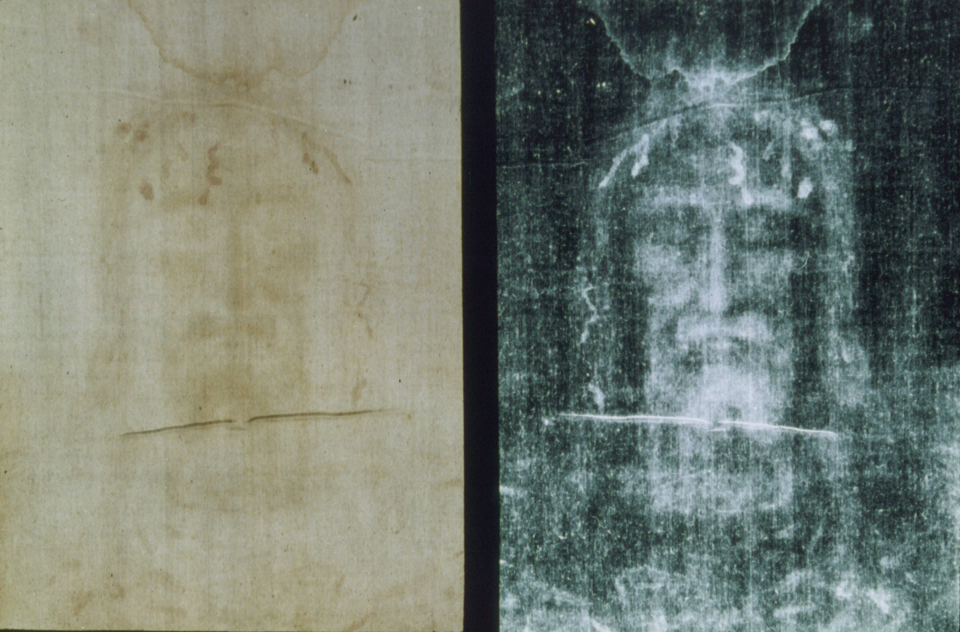
Shroud of Turin, linen cloth bearing the faint image of a man, photographic reproduction of a medieval relic. Public domain.
Oresme’s Case Against the Shroud
Doubts about the Shroud of Turin did not rest on intuition alone. Nicole Oresme approached the question with a structured argument grounded in probability, observation, and institutional context.
No clear evidence suggests that Oresme personally examined the Shroud. His critique focused on the claims surrounding it. A relic of such significance would require clear provenance and consistent testimony, yet neither appeared in accounts tied to its emergence.

Nicole Oresme at study, from “Traité de la sphère,” manuscript illumination, early 15th century. Public domain.
Oresme also considered human incentives. Clergy and local institutions benefited from relics that attracted pilgrims, status, and revenue. In that setting, fabrication was not remote but rational.
His conclusion followed directly. When evidence is weak and incentives are strong, skepticism is warranted. The Shroud fit that pattern.
The argument feels familiar today. It reflects a disciplined mode of reasoning that predates modern science yet arrives at a comparable standard of proof.
Science Confirms What Was Already Suspected
Modern analysis reinforces those early conclusions. Radiocarbon dating places the cloth in the medieval era. Material studies indicate techniques available at the time could produce the image. No broadly accepted mechanism supports its origin as a burial imprint.
Modern analysis reinforces those early conclusions. Radiocarbon dating places the cloth in the medieval era. Material studies indicate techniques available at the time could produce the image. No broadly accepted mechanism supports its origin as a burial imprint.
A 2025 computational study by Cícero Moraes adds a final layer. Using digital 3D modeling, the study tested how an image would form from a fully wrapped human body compared with a low relief surface. The results indicate that the Shroud’s image aligns more closely with a low relief model, as a fully three dimensional body would produce greater distortion than observed.
The continuity stands out. Medieval reasoning, laboratory testing, and computational modeling converge despite their different methods.
A familiar pattern appears. Artifacts tied to meaning and identity often persist beyond the strength of the evidence supporting them. Early critiques remain present yet unheeded, even when clearly articulated.
When Evidence Is Not Enough
The history of the Shroud of Turin points to a final lesson. Evidence, even when consistent across centuries, does not always settle belief.
Faith operates on a different axis. It draws strength from tradition, identity, and meaning rather than verification alone. For many, the value of the Shroud lies not in whether it can be proven authentic, but in what it represents.
Other objects follow a similar path. The Crown of Thorns, the True Cross, and the Holy Grail have all been venerated across centuries despite uncertain or contested provenance. Their significance endures not through verification, but through the meaning attached to them. That tension has endured from the 14th century to the present.
Evidence can close a case, but it rarely closes belief.
Further Reading
Radiocarbon Dating of the Shroud - Nature, 1988