The Undersea Aircraft Carrier
A future submarine carrying hundreds of autonomous aerial drones could combine the stealth of undersea warfare with the reach of naval aviation, creating a hidden aircraft carrier capable of projecting intelligence and influence across an entire region at a fraction of the cost of a traditional carrier.
For nearly a century, aircraft carriers have served as the principal instruments of naval power projection. Since the Second World War, they have functioned as floating airfields capable of projecting power across entire oceans. Their influence rests on a simple principle: a ship that carries aircraft can see farther, strike farther, and control a larger area than a ship relying solely on its own weapons and sensors.
Advances in autonomy and artificial intelligence may now be creating a different kind of carrier, one that operates entirely beneath the surface.
Submarines have always possessed a powerful advantage. Unlike surface warships, they are designed not to be seen. A carrier strike group announces its presence wherever it sails. Satellites track it. Aircraft monitor it. Intelligence services know roughly where it is operating. A submarine creates uncertainty. An adversary may suspect it is nearby, but cannot easily determine its location.
That stealth comes at a cost. Hidden vessels have traditionally suffered from limited awareness. A submarine can hear and observe only so much from beneath the waves. For more than a century, naval engineers have worked to overcome that limitation through improved sonar, periscopes, communications systems, and satellite links.
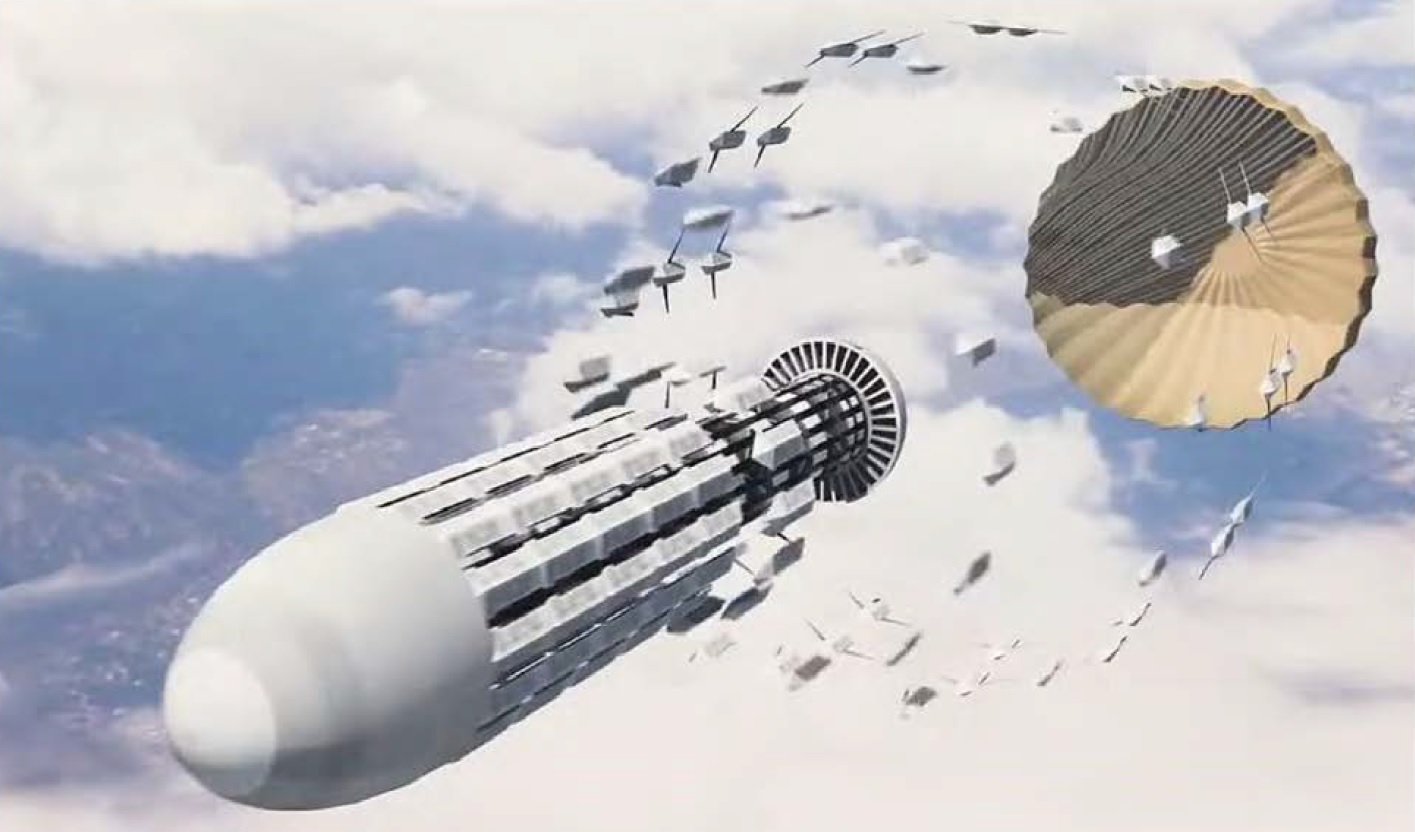
Air Force Research Laboratory concept of a mass launched drone swarm. Technologies originally developed for airborne deployment may one day enable submarines to release hundreds of autonomous aircraft from beneath the ocean's surface. Air Force Research Laboratory, 2019. Public domain.
Aerial drone swarms may offer a more dramatic solution.
Imagine a submarine carrying hundreds of compact drones in dedicated launch cells. Upon reaching a strategic location, the vessel releases the swarm. Within minutes, hundreds of autonomous aircraft spread across the sky, creating a reconnaissance and communications network far larger than anything the submarine could achieve on its own. Some drones track ships. Others monitor coastal installations. Additional platforms relay communications, identify targets, conduct electronic warfare missions, or act as decoys. The result is a remarkable inversion of traditional naval aviation. A submarine remains hidden beneath the ocean while projecting air power above it.
History offers an interesting parallel. Before the rise of naval aviation, battleships represented the pinnacle of maritime power. Their massive guns and armor defined military strength at sea. Aircraft carriers initially appeared to be supporting vessels, useful for reconnaissance but secondary to the battle fleet. That assumption proved short lived. Aircraft extended a fleet's reach beyond the horizon and fundamentally changed naval warfare. By 1945, the carrier had replaced the battleship as the dominant capital ship.
Drone swarms may represent a similar shift. Aircraft carriers project power through manned aircraft. Future submarines may project power through hundreds of autonomous aircraft. The comparison is not exact, yet both technologies expand awareness and influence far beyond the host vessel itself.
The economics are equally intriguing. A modern nuclear aircraft carrier costs roughly $13 to $15 billion to build before accounting for its air wing, escorts, logistics support, and lifetime operating expenses. A modern attack submarine costs roughly one third as much while presenting a far more difficult targeting problem. For the price of a single carrier, a navy could potentially field several drone equipped submarines operating simultaneously across different regions.
That comparison raises uncomfortable questions. Is a carrier strike group more valuable than three submarines, each capable of releasing hundreds of autonomous aircraft across a contested region while remaining largely invisible to an adversary? Military planners are increasingly exploring those questions as autonomous technology improves.
The strategic implications become especially apparent in contested waterways such as the Strait of Hormuz. A surface fleet entering the region is immediately visible to satellites and coastal surveillance systems. A submarine may enter unnoticed. Once in position, it could launch an aerial drone swarm numbering in the hundreds. The swarm could monitor shipping traffic, observe military installations, track naval movements, relay communications, and create a persistent surveillance network stretching across the region. The submarine itself could remain hidden beneath the surface throughout the operation. In effect, an invisible vessel would have created a temporary air force over one of the world's most strategically important waterways. The uncertainty alone could complicate an adversary's planning.
Challenges remain significant. Underwater communications are difficult. Recovering drones presents logistical hurdles. Autonomous aircraft remain vulnerable to electronic warfare and air defenses. Aircraft carriers also perform missions that submarines cannot easily replicate, including sustained manned air operations, humanitarian assistance, and visible deterrence.
For those reasons, submarine drone carriers are unlikely to replace aircraft carriers in the near future.
A more plausible future involves a gradual shift toward distributed naval power. Surface carriers would continue operating alongside submarines, yet some of the reconnaissance and surveillance missions currently performed by carrier aircraft could migrate to autonomous swarms launched from beneath the sea.
Information has become as important as firepower in modern warfare. Aircraft carriers solved the information problem of the twentieth century through aviation. Autonomous aerial swarms may solve it for submarines in the twenty first.
If that happens, historians may conclude that naval aviation did not disappear. It simply moved beneath the waves.
Further Reading