What Do Octopuses and Dogs Have in Common?
The book - The Mountain in the Sea - makes us think about how difficult it is to recognize intelligence when it does not look like our own.
I am reading Ray Nayler's The Mountain in the Sea, a novel built around a deceptively simple question: what would happen if humans discovered another intelligent species on Earth?
Not an alien civilization arriving from another star, but an intelligence that evolved alongside us, hidden in the oceans.
Scientists in the novel attempt to communicate with a population of unusually intelligent octopuses. Their challenge is not proving intelligence exists. Their challenge is recognizing it. The octopuses do not speak, build cities, or organize themselves according to human expectations. Researchers must confront an uncomfortable possibility. Intelligence may exist in forms that do not resemble our own.
The novel's central question extends far beyond marine biology. It reaches into artificial intelligence, philosophy, and the way humans understand themselves.
The Recognition Problem
Modern artificial intelligence raises a similar challenge. We often evaluate AI through tests designed by humans, benchmarks created by humans, and conversations conducted in human language. When systems excel at those tasks, we call them intelligent. When they fail at something a child can do, we question whether intelligence was present at all.
History suggests caution. Machines have repeatedly succeeded in domains once considered uniquely human, from chess to Go to increasingly sophisticated forms of reasoning. At the same time, they continue to make mistakes that no human would make.
Perhaps the problem is not the machine. Perhaps the problem is our definition of intelligence. Nayler's octopuses force the same realization. Intelligence may be easier to recognize when it looks like us. The greater challenge emerges when it does not.
The Understanding Problem
Humans have lived alongside dogs for thousands of years. We hunt with them, work with them, train them, breed them, and study them. Entire scientific disciplines examine canine cognition. Yet a basic mystery remains.
A dog experiences a world saturated with information that humans cannot perceive. Every tree, sidewalk, and patch of grass contains a history written in scent. Dogs identify individuals through smell, detect emotional states, and navigate a sensory landscape that has no true human equivalent.
We know dogs experience that world. We can measure their responses to it. What we cannot do is experience it ourselves.
Dogs are among the most familiar animals on Earth. Even after millennia of coexistence, part of their inner experience remains inaccessible to us. If understanding a dog remains incomplete, what hope do we have of fully understanding an octopus, an artificial intelligence, or any future form of mind that evolved along a different path? The challenge may not be identifying intelligence. The challenge may be escaping the limits of our own perspective.

An Amphioctopus marginatus carries shells for later use as a protective shelter, demonstrating a form of tool use that challenges traditional assumptions about animal intelligence. Photograph by Nick Hobgood, Timor-Leste, 2006. Wikimedia Commons, CC BY-SA 3.0.
The Ethics Problem
The Mountain in the Sea pushes beyond recognition and understanding. The novel asks whether humans can recognize other minds, but it also asks whether our political and economic systems are capable of responding ethically when they do. Once the possibility of octopus intelligence emerges, the central challenge is no longer scientific. It becomes political, economic, and moral - how should society respond to a newly discovered intelligence?
Can institutions built around ownership, profit, surveillance, and control accommodate something that may deserve rights, autonomy, or protection?
Dogs provide an instructive example. Most societies no longer treat dogs as mere property, yet neither do they grant them personhood. Instead, we created a middle category built around welfare and protection. Recognition alone did not answer the harder question. What do we owe another intelligent creature?
Science can establish that another mind exists. Science alone cannot tell us how that mind should be treated.
For centuries, people imagined intelligence as a ladder with humans at the top. A more useful metaphor may be an ecosystem. Different forms of intelligence emerge under different conditions, each adapted to its own environment, each solving problems in ways that may appear strange to outsiders.
The most unsettling possibility raised by The Mountain in the Sea is not that intelligent octopuses might exist. Nor is it that artificial intelligence may someday rival human intelligence.
The unsettling possibility is that intelligence has no universal form.
If that is true, then the defining challenge of the twenty first century may not be building intelligent systems. It may be learning how to recognize intelligence when it arrives in forms we did not expect, understanding that some minds may always remain partly beyond our comprehension, and deciding what obligations follow once we acknowledge they are there.
What do octopuses and dogs have in common?
Both remind us that recognizing another mind is easier than understanding it, and understanding it may be easier than deciding what we owe it.
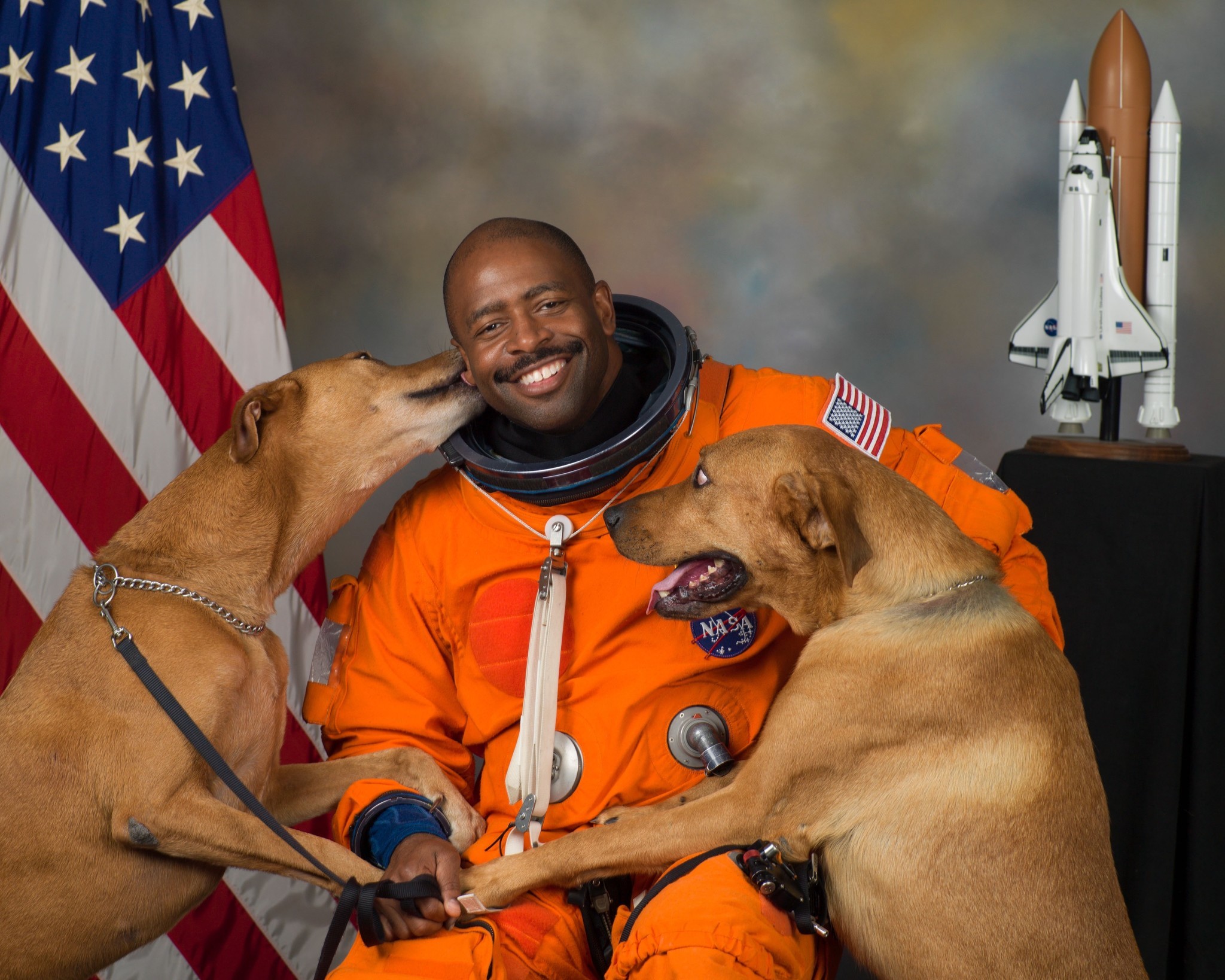
NASA astronaut Leland D. Melvin with his rescue dogs, Jake and Scout. Humans have lived alongside dogs for thousands of years, yet their experience of the world remains fundamentally different from our own. NASA photograph by Robert Markowitz, 2009. Public domain.
Further Reading