What Is the Magic Sphere in the Acropolis Museum?
An unusual marble sphere from Roman Athens covered in divine names, magical syllables, and the language of ancient ritual.
In the Acropolis Museum in Athens sits an unusual artifact: a marble sphere roughly the size of a bowling ball, its entire surface covered with sequences of Greek letters and strange syllables. The museum calls it simply a “magic sphere.” The object dates to Roman-period Athens, likely from the second or third century CE. Unlike astronomical globes, which show constellations, the surface contains inscriptions that resemble formulas preserved in the Greek Magical Papyri, a collection of ritual texts from the Greco-Roman world. The sphere therefore appears to be a ritual instrument rather than a scientific model.
Greek philosophers long treated the sphere as the perfect shape of the cosmos. In traditions influenced by Plato and later cosmological thought, the universe itself was imagined as spherical and mathematically harmonious. A marble sphere covered with sacred letters may therefore represent a universe structured by language. Instead of stars, its surface carries words believed to hold divine or cosmic power.
The Object at the Acropolis
The object itself is striking. Carved from marble and roughly the size of a bowling ball, the sphere is covered with inscriptions arranged across its curved surface. The letters do not form ordinary sentences. They include repeating alphabets, unusual letter sequences, and mysterious syllables similar to those preserved in the Greek Magical Papyri. The artifact belongs to Roman-period Athens, a time when the city remained an intellectual center where philosophy, religion, astrology, and ritual practice intersected.
The sphere is reported to have been discovered on the south slope of the Acropolis, in the vicinity of the Theater of Dionysus. Only a short distance away stood the Sanctuary of Asclepius, the principal healing complex of the city dedicated to Asclepius. In Roman Athens this entire slope formed a dense ritual landscape where theaters, shrines, and healing sanctuaries stood side by side. The precise archaeological context of the sphere remains uncertain, but the location places it within one of the most active religious areas of the ancient city.
The spherical form itself may be meaningful. Greek cosmology frequently described the universe as a sphere, the most perfect geometric form because it is symmetrical in all directions. Philosophical texts treated the heavens as a system of celestial spheres carrying the planets and stars. In that intellectual environment, a sphere could symbolize the structure of the cosmos itself.
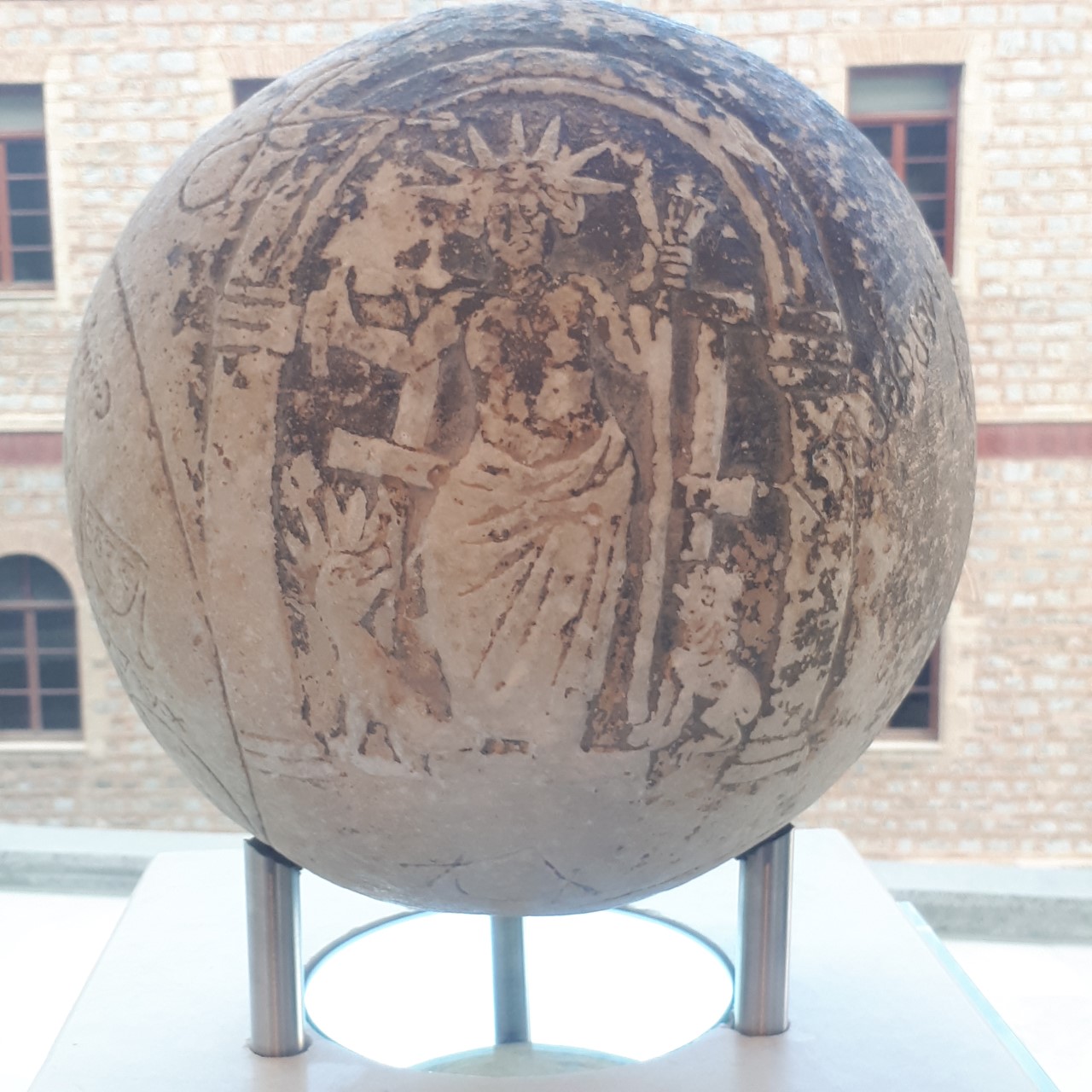
Greek magical sphere depicting Helios, Acropolis Museum, Athens. Photo by Deiadameian / Wikimedia Commons, CC BY-SA 4.0.
The inscriptions suggest that the sphere did not function as an astronomical model. No constellations appear on its surface. Instead the sphere encodes language. Sacred names, vowel sequences, and repeating alphabets cover the surface in a dense network of symbols. Rather than mapping the heavens visually, the artifact may represent the cosmos through sound and language.
Some scholars also note that the Greek alphabet doubled as a numerical system in antiquity. Each letter corresponded to a number. Complete alphabets carved on ritual objects could therefore hint at the idea that the structure of reality could be expressed through a finite symbolic system of letters and numbers. The sphere may therefore represent a symbolic universe composed not of stars but of language.
An AI-Assisted Reading of the Triangle
One side of the sphere contains a striking geometric diagram: a triangle enclosed within a circle, with a sequence of Greek letters carved along each of the three sides. At first glance the inscriptions are difficult to interpret. The letters do not form recognizable Greek words and resemble the voces magicae commonly found in ritual texts such as the Greek Magical Papyri—strings of sacred syllables believed to possess power through sound rather than ordinary meaning.
To explore whether another layer of structure might be present, I performed a small computational experiment using ChatGPT (GPT-5.3) together with a high-resolution photograph of the sphere from the Acropolis Museum’s website. The system was used to help identify the visible letters and then analyze them according to the Greek alphanumeric system, in which letters also function as numbers.
In that system:
- Α = 1
- Ε = 5
- Ι = 10
- Ν = 50
- Π = 80
- Υ = 400
- Ω = 800
One sequence visible along a side of the triangle appears close to ΑΝΝΙΑΕΥ, which converts numerically to:
1 – 50 – 50 – 10 – 1 – 5 – 400
Another sequence includes Ω (omega), which carries the very large value 800. When the inscriptions are examined numerically, several patterns appear. The sequences combine clusters of small numbers with occasional very large values, and some letters—especially Ν (50)—repeat in rhythmic ways that resemble amplification patterns seen in magical formulas.
The analysis does not reveal a clear harmonic ratio such as the classical musical proportions known from Greek theory. Yet the exercise highlights something important about the object: in the ancient world letters, numbers, and sounds were not separate systems. Greek letters functioned simultaneously as phonetic symbols, numerical values, and sacred signs.
Seen within the geometry of a triangle inside a circle carved onto a sphere, the inscriptions may therefore represent an attempt to combine language, number, and geometry into a single symbolic structure. Rather than encoding a simple mathematical formula, the triangle likely formed part of a broader cosmic diagram in which sacred syllables and numerical symbolism were arranged to express or invoke the order of the universe.
Divine Names and Voces Magicae
The inscriptions include two types of expressions common in Greco-Roman ritual texts: divine names and what scholars call voces magicae, or “magical words.” Divine names refer to the names of gods invoked during ritual practice. In the magical papyri these often combine elements from several religious traditions. Greek, Egyptian, and Jewish divine titles appear side by side. Names such as IAO, Sabaoth, Adonai, or Abrasax appear frequently in magical invocations. Practitioners believed that knowing and pronouncing a divine name could summon or channel a deity’s power.
Alongside these names appear the voces magicae, strange syllables that often seem meaningless. Examples include long vowel sequences such as AEIOU or invented words like Semesilam. Scholars suggest that some of these may preserve fragments of older ritual languages, while others were deliberately constructed. Their sound was believed to carry power independent of ordinary meaning. Chanting these syllables formed part of ritual practice.
Objects inscribed with such formulas frequently appear in magical traditions connected with healing and protection. Ritual specialists in the Greco-Roman world often invoked divine names and sacred syllables to restore health, ward off illness, or call upon divine assistance. The sphere’s reported findspot near the Theater of Dionysus, immediately beside the Sanctuary of Asclepius—the Greek god of healing—strongly suggests that it may have been used in rituals connected with healing or protection. Sanctuaries dedicated to Asclepius functioned in many ways like ancient hospitals, where supplicants sought cures through ritual, incubation dreams, and divine intervention.
The imagery visible on the sphere strengthens that interpretation. One side depicts the sun god Helios seated beneath an arch as Kosmokrator, ruler of the cosmos. Solar imagery played an important role in late antique ritual practice, where sunlight symbolized purification, vitality, and cosmic order. In some magical traditions Helios appears as a powerful divine witness invoked during healing rites.
One intriguing possibility connects these vocal formulas with ancient harmonic theory. Greek thinkers had long associated mathematics, music, and cosmic order. The Pythagorean tradition, associated with Pythagoras, argued that musical harmony followed numerical ratios and that the cosmos itself reflected the same structure. Philosophers later described the universe as a system of celestial spheres whose motions produced a mathematical harmony sometimes called the “music of the spheres.”
Within that intellectual world, vowel chants may have been understood as attempts to reproduce cosmic sound. The long vowel sequences preserved in magical texts resemble vocalized tones rather than ordinary speech. If practitioners believed that divine forces operated through cosmic harmony, reciting these sounds could have been imagined as aligning human speech with the structure of the universe.
Seen in this light, the marble sphere takes on a richer meaning. Its shape reflects the geometry of the cosmos. Its surface carries divine names and ritual syllables believed to contain sacred power. The object may have served as a ritual instrument through which language, sound, cosmology, and healing were brought together.
The temples of Athens represented the official religion of the city. Objects like the magic sphere reveal another layer of ancient spirituality. Philosophical ideas about cosmic harmony, mathematical symbolism, sacred language, and healing practice appear here not in theoretical texts but carved into stone, suggesting that some practitioners believed the structure of the universe could be invoked in the service of human health and protection.
Further Reading
Official description of the artifact at The Acropolis Museum