When Logic Became a Graphic Novel
A comic tells the story of the twentieth century crisis in the foundations of mathematics.
The visual storytelling of Logicomix
Few subjects seem less suited to a comic book than the foundations of mathematics. Yet Logicomix, published in 2009 and written by Apostolos Doxiadis and Christos H. Papadimitriou, shows that even the most abstract intellectual debates can be told visually. The graphic novel follows Bertrand Russell’s search for a secure logical foundation for mathematics, a quest that shaped early twentieth-century philosophy and logic. Instead of presenting ideas through symbolic notation or equations, the book places Russell and his contemporaries into scenes of conversation, lectures, and philosophical confrontation.
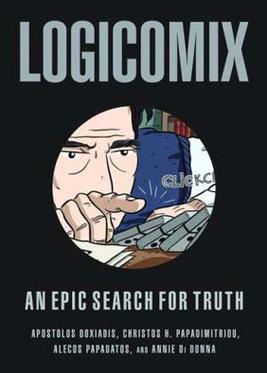
Logicomix: An Epic Search for Truth, cover of the English-language edition. Illustration by Alecos Papadatos, Bloomsbury, 2009.
The narrative opens with Russell delivering a lecture in the United States in September 1939, just as Europe is descending into war. From there the story moves backward through Russell’s life, tracing the intellectual struggles that defined the early development of modern logic. The book introduces many figures who shaped this debate. Gottlob Frege appears as the logician whose work inspired Russell’s program. Georg Cantor represents the revolutionary founder of set theory, whose ideas transformed mathematics even as he struggled with mental illness late in life. David Hilbert embodies the optimism of mathematicians who believed that formal logic could ultimately secure the foundations of the entire discipline.
The comic format allows these historical figures to appear not as abstract names in textbooks but as participants in a shared intellectual drama. Conversations unfold in lecture halls, cafés, and private studies. Rivalries and disagreements become part of the narrative. By presenting philosophical debates through visual scenes, the graphic novel turns what might otherwise be a technical history into a story about people confronting profound intellectual problems. The medium itself becomes part of the explanation: visual storytelling helps readers grasp how ideas develop through personalities, disputes, and intellectual ambition.
Why did the foundations of mathematics collapse?
Russell’s paradox and Gödel’s answer
The historical problem at the center of the story began in 1901 when Russell discovered what became known as Russell’s paradox. The puzzle arises from a simple problem of self-reference. Imagine a barber who shaves everyone in a town who does not shave himself. Who shaves the barber? If he shaves himself he should not, and if he does not shave himself he must. The paradox revealed a contradiction hidden within naïve set theory, the framework many mathematicians believed could serve as the logical foundation of all mathematics.
Russell attempted to repair this problem through the monumental work Principia Mathematica, written with Alfred North Whitehead and published between 1910 and 1913. Their goal was to derive arithmetic entirely from symbolic logic using a carefully constructed hierarchy of rules. The project became famous for the extraordinary level of detail required to build the system. Hundreds of pages pass before the authors formally prove the proposition that one plus one equals two. Behind the technical achievement stood a much larger ambition: the hope that mathematics could rest on a perfectly secure logical foundation.
That ambition ultimately failed. In 1931 Kurt Gödel demonstrated that any sufficiently powerful logical system will contain true statements that cannot be proven within the system itself. Gödel’s incompleteness theorems showed that the search for absolute certainty in mathematics could never fully succeed. The result reshaped twentieth-century philosophy and influenced later developments in computer science, where the limits of formal systems remain a fundamental issue.
Logicomix presents this intellectual turning point not simply as a technical result but as the dramatic conclusion to a long search for certainty. By telling the story as a graphic novel, the book reminds readers that even the most abstract ideas emerge from human struggles to understand knowledge, logic, and the limits of reason.
Further Reading